 Sudden Valley Window
 Why Ferndale Roofs Wear Differently Than Roofs Inland
Ferndale sits close enough to the water and to the lowland river valley that its roofs take a different kind of beating than a roof twenty miles inland. Salt-laden air moves in off the Strait and Bellingham Bay, driving rain comes in sideways more often than it falls straight down, and the wet season here doesn't really end in a month or two — it settles in and stays. Add the shade from mature conifers on a lot of Ferndale properties, and you have the three ingredients that shorten the life of an asphalt shingle roof faster than the manufacturer's warranty paperwork suggests: corrosion at metal fasteners and flashing, water intrusion at laps and valleys that aren't sealed correctly, and moss that works its way under shingle tabs and lifts them.
None of this means asphalt shingles are a poor choice for Whatcom County. They're still the most practical, cost-effective roofing material for the vast majority of homes here. It means the installation details matter more in Ferndale than they do in a dry climate, and a roof that was installed to a generic spec — rather than one built for driving rain and a long moss season — will show its age early.
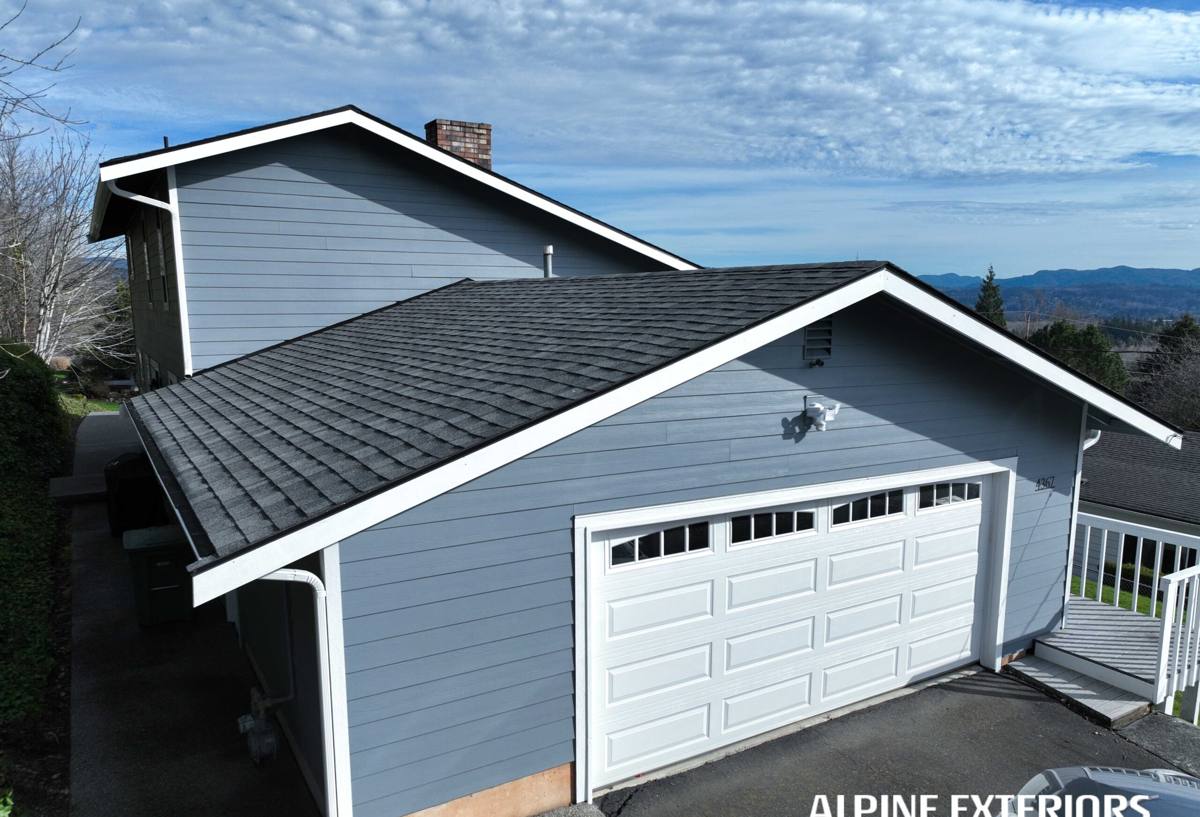
What a Correct Shingle Roof Needs in This Climate
A shingle roof is a system, not just a layer of shingles nailed to plywood. In a climate like ours, every layer of that system earns its keep.
Underlayment and Ice/Water Protection
Standard felt underlayment is the minimum, not the goal. In areas that see driving, wind-blown rain — which is most of Ferndale in the winter months — a synthetic underlayment with better lap sealing and tear resistance holds up longer under wind uplift and repeated wetting. Self-adhered membrane at eaves, valleys, and around penetrations is cheap insurance against the wind-driven rain that gets pushed backward under shingle tabs during a real storm.
Flashing That's Actually Sealed, Not Just Placed
Most leaks we get called out for aren't shingle failures — they're flashing failures around chimneys, skylights, sidewalls, and roof-to-wall transitions. Salt air accelerates corrosion on cheaper galvanized flashing and exposed fasteners, so we favor materials and fastener types that hold up to that exposure rather than the lowest-cost option.
Ventilation That Matches the Attic
Whatcom County's humidity doesn't just affect the outside of the roof — it affects the attic. An under-ventilated attic traps moisture from everyday household use, and that moisture condenses on the underside of the decking, which rots plywood and voids shingle warranties from the inside long before the shingles themselves fail. Balanced intake (soffit) and exhaust (ridge or box vents) ventilation is not optional in this climate; it's part of what makes the shingles last their rated life.
Signs a Ferndale Roof Needs Attention
Because moss and moisture damage build slowly, a lot of homeowners don't notice a problem until it's already inside the attic. These are the signs worth walking your roofline for, or having us check during a free estimate:
- Moss or dark algae streaking concentrated on the north- or shade-facing slopes
- Granules collecting in gutters or at downspout outlets
- Shingle tabs that look slightly lifted or curled at the edges, especially near valleys
- Soft spots underfoot on the roof, or sagging visible from the ground
- Water stains or a musty smell in the attic near the ridge or around chimneys
- Daylight visible through the roof deck from inside the attic
- Rust streaks below metal flashing or exposed fasteners
Any one of these on its own may not mean a full replacement is needed. But in a climate that doesn't give a roof much of a drying-out period between rain events, small problems compound faster here than they would somewhere drier.
Choosing a Shingle for Salt Air, Rain, and Moss
Not every asphalt shingle product is a good fit for this specific combination of conditions. Here's how the common classes compare for a Ferndale roof:
| Shingle type | Wind resistance | Algae/moss resistance | Best fit here |
|---|---|---|---|
| Standard 3-tab | Lower — more exposed tab edges | Standard granules only | Budget re-roofs on low-exposure slopes |
| Architectural / laminate | Higher, rated for stronger gusts | Usually available with algae-resistant granules | Most Ferndale homes — our default recommendation |
| Premium/designer laminate | Highest in the asphalt category | Algae-resistant standard, thicker mat | Shaded lots, north-facing roofs, longer hold before re-treatment |
We specifically look for shingles with algae-resistant (AR) granules — usually a copper- or zinc-based additive — on any roof with tree cover or a north-facing slope, which describes a large share of Ferndale properties. It won't stop moss forever, but it slows the growth cycle meaningfully compared to standard granules, and it's a small cost difference for a real difference in how the roof looks and performs five and ten years out.
Why We Don't Push the Cheapest Option
We'll install a basic 3-tab shingle if that's what a budget calls for, and we'll say so plainly if we think it's a poor match for a particular roof. Our concern with the cheapest tier of shingle in this climate isn't the brand — it's that thinner mats and standard granules give moss and moisture less resistance to work against, which usually means a shorter real-world service life and more maintenance calls in between, not necessarily a shorter warranty period on paper.
How Our Roofing Process Works
- On-site inspection. We walk the roof (weather permitting) or inspect from the attic and eaves, check for soft decking, moss buildup, flashing condition, and ventilation, and take measurements.
- Written estimate. You get a clear scope — tear-off or overlay, underlayment type, flashing work, ventilation changes, shingle selection — with no vague allowances.
- Scheduling around the weather. Given how often Whatcom County sees rain, we plan tear-off days around forecast windows and keep the roof dried in at the end of each work day rather than leaving decking exposed overnight.
- Tear-off and deck inspection. Old material comes off down to the deck so we can actually see and repair any soft or rotted plywood — this is where hidden moisture damage from years of minor leaks shows up.
- Underlayment, flashing, and ventilation installed. This is the layer that does the most work in our climate, and it's the layer that's invisible once the shingles go down.
- Shingle installation. Installed to manufacturer nailing pattern and exposure specs — not "close enough" — since improper nailing is a common cause of early wind and water damage.
- Cleanup and final walk-through. Magnetic sweep for stray fasteners, gutter check, and a walk-through so you know what was done and what to watch for going forward.
Ventilation and Moisture: The Part You Don't See
We mentioned ventilation above because it's worth repeating on its own: in a marine climate like ours, a roof can fail from the inside out. Warm, moist indoor air rises into the attic, and if it can't escape through balanced intake and exhaust vents, it condenses on cold roof decking during the long stretch of cool, damp months Whatcom County gets every year. Over time that condensation rots the deck, feeds mold, and undercuts the shingles from below — which is a very different problem than wind or age wearing shingles out from above, and one a shingle warranty won't cover. When we replace a roof, checking and correcting attic ventilation is a standard part of the estimate, not an upsell.
Living With Moss: Realistic Maintenance for This Area
No roofing material, asphalt or otherwise, is moss-proof in a climate this wet and shaded. The honest goal is managing it, not eliminating it. A few habits go a long way on a Ferndale roof:
- Keep overhanging branches trimmed back to let more light and airflow reach shaded slopes
- Clear gutters and valleys of needle and leaf litter at least twice a year — trapped debris holds moisture against the shingles
- Have moss treated (not power-washed, which can strip granules) before it gets thick enough to lift tabs
- Check zinc or copper control strips if your roof has them, and consider them on a re-roof if moss has been a recurring problem
What Drives the Cost of a Ferndale Re-Roof
| Factor | Why it matters here |
|---|---|
| Tear-off vs. overlay | Full tear-off is usually the right call in this climate since it's the only way to find and fix hidden deck rot from long-term moisture |
| Roof pitch and access | Steeper roofs and limited access add labor time and safety setup, which shows up in the bid |
| Deck repair | Rotted or soft plywood found at tear-off has to be replaced before shingles go down — this is common on older roofs with a moss or leak history |
| Ventilation upgrades | Adding or correcting intake/exhaust venting is a modest add during a re-roof and a much bigger job later |
| Shingle class chosen | Architectural and algae-resistant lines cost more per square than basic 3-tab, but typically hold up longer under our conditions |
We don't publish blanket price lists because roof size, pitch, deck condition, and shingle choice swing the total too much for a number to mean anything until we've actually seen the roof. What we can tell you upfront is that skipping deck repair or ventilation to hit a lower number tends to cost more later in this climate than it saves now.
Why Local Roofing Experience Matters in Ferndale
A crew that already works Whatcom County roofs knows which slopes in a given neighborhood hold moss longest, how to schedule tear-off around the rain patterns that are typical here rather than generic seasonal averages, and which flashing and fastener choices actually hold up to the salt air near the water versus further inland. That's not something a crew based somewhere dry picks up on the first job. It also means we're not guessing at permitting requirements or driving in from out of the area if a warranty callback comes up — we're already here, working roofs like yours on a regular basis.
Get a Straightforward Look at Your Roof
If your Ferndale roof is showing moss, granule loss, or you just haven't had it looked at in a while, we're happy to come take a look and give you a straight answer — repair, partial replacement, or full re-roof — with no pressure either way. The form below gets you a free estimate scheduled.