 Sudden Valley Window
 Why Silver Beach Homes Take a Different Kind of Weather Beating
Silver Beach sits along Lake Whatcom inside the Sudden Valley area of Whatcom County, tucked into tree cover and shaped by the marine-influenced air that moves through this part of northwest Washington. That combination is deceptively hard on exterior siding. Homes here don't just get rain — they get long stretches of driving, wind-pushed rain off the lake and surrounding hills, followed by weeks of damp, low-light conditions that never quite dry the wall out between storms. Add the tree canopy that shades large sections of most lots, and you get one of the more demanding microclimates for siding in the county.
That shade and moisture combination is also exactly what moss needs to thrive, and moss season here isn't a few weeks in spring — it's most of the year. Homeowners who've lived in Silver Beach for any length of time already know this. What often catches people off guard is how much that moisture and moss cycle matters when it's time to re-side a home, and how much a siding product's ability to shed water and resist that cycle affects how the job holds up ten and twenty years down the road.
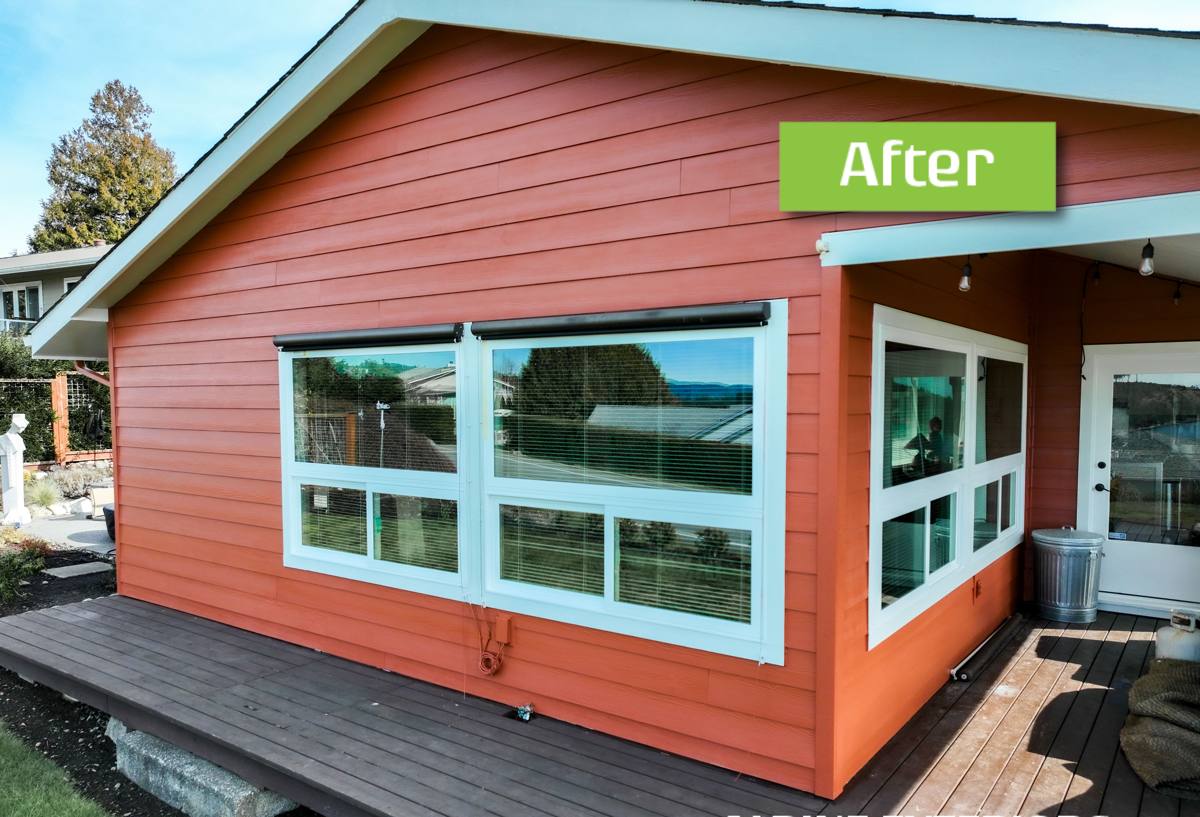
What Constant Moisture and Moss Actually Do to Siding
Moss Is a Moisture Problem, Not a Cosmetic One
Moss doesn't just sit on top of siding — it holds a thin film of moisture against the surface for days at a time, even after the rain stops. On siding with any texture, seams, or exposed cut edges, that trapped moisture works its way in over repeated cycles. The damage isn't usually dramatic; it's slow, and it shows up years later as soft spots, discoloration, or fastener failure that nobody saw coming.
Why Wood-Based Products Struggle Here
Wood siding and wood-based composite panels can perform fine in drier climates, but they're built around a material that swells and contracts with moisture. In a climate that stays damp for months at a stretch, cut edges, butt joints, and any spot where the factory coating gets compromised become the weak points. Keeping that kind of siding sound in Silver Beach means staying on top of caulking, touch-up paint, and edge sealing more or less indefinitely. That's a real maintenance commitment, and it's one reason we made a decision early on about what we'd put on homes in this area.
Why We Install Only James Hardie Fiber Cement Here
We install one siding product, on every job, in every neighborhood we work: James Hardie fiber cement. It isn't wood, it isn't a wood composite, and it doesn't behave like either one when it's wet. Fiber cement is dimensionally stable — it doesn't swell, cup, or delaminate the way organic and wood-fiber-based products can when they take on repeated moisture. In a climate like Silver Beach's, that stability is the difference between siding that looks the same in year fifteen and siding that's already showing edge damage by year seven.
James Hardie also engineers its products by climate zone rather than shipping one formulation nationwide. The version installed in western Washington is formulated for a wetter, more temperature-variable climate than what you'd install in the desert Southwest. On top of that, most of what we install carries Hardie's ColorPlus factory finish — a baked-on finish applied under controlled conditions, rather than field paint applied on site in whatever weather shows up that week. That matters here specifically, because field-applied paint has to fully cure before the next rain, and in Silver Beach's damp stretches, that window can be hard to find. Hardie siding is also non-combustible, which matters given how much of this area is wooded, and it carries a strong transferable limited warranty that follows the house, not just the original owner.
What a Correct Installation Involves in This Climate
The Water-Resistive Barrier and Rainscreen Gap
The siding itself is only part of the system. Behind it, every wall needs a continuous water-resistive barrier, properly lapped and taped at every seam, penetration, and window opening. In a climate that sees as much sustained wet weather as Silver Beach does, we also build in a rainscreen gap — a thin drainage and ventilation space between the barrier and the back of the siding — so that any moisture that does get past the cladding has somewhere to drain and dry out instead of sitting against the wall assembly.
Flashing Is Where Most Failures Actually Start
Nearly every siding failure we're called out to inspect traces back to a flashing detail, not the siding material itself. Window and door head flashings, kick-out flashing where a roofline meets a wall, and proper step flashing at roof transitions all have to be installed in the correct order, before the siding goes on, not caulked in as an afterthought. On a lake-adjacent property with heavy tree cover, water is going to find any shortcut in these details eventually.
Fastening, Clearances, and Caulking
James Hardie specifies exact fastener types, spacing, and placement for each product line, along with minimum clearances from grade, roof lines, and horizontal surfaces like decks and patios. Skipping those clearances is one of the most common installation mistakes we see on re-side jobs, and it's a direct path to trapped moisture at the bottom courses. Caulking has a role, but only at specific joints called for in the manufacturer's instructions — over-caulking a joint that's supposed to allow drainage or movement causes more problems than it solves.
Our Installation Process for Silver Beach Homes
- On-site assessment: We look at existing siding condition, sheathing access points, moss and moisture patterns on the specific lot, tree cover, and drainage around the foundation.
- Tear-off and sheathing inspection: Old siding comes off and we inspect the sheathing underneath for rot or soft spots before anything new goes up. Any compromised sheathing gets repaired or replaced, not covered over.
- Water-resistive barrier and rainscreen installation: A continuous, properly lapped barrier goes on first, followed by furring strips or a manufactured rainscreen product to create the drainage gap.
- Flashing installation: All window, door, and roofline flashing details are installed before siding panels go up, in the sequence that actually sheds water downward and outward.
- James Hardie siding installation: Panels or lap siding are installed to manufacturer fastening specifications, with the correct clearances at grade, roof, and deck transitions.
- Trim, corners, and final caulking: Trim and corner details are finished, with caulking limited to the joints where it's actually specified.
- Final walkthrough and cleanup: We walk the finished job with the homeowner and clear the site of old material and debris.
Cost Factors for a Silver Beach Siding Project
Every home is different, and we don't quote a job without seeing it, but these are the factors that most often move a Silver Beach siding project up or down in price:
| Factor | Why It Matters Here | Typical Impact |
|---|---|---|
| Sheathing condition | Long-term moisture exposure sometimes means hidden rot behind old siding | Can add repair cost once walls are opened up |
| Home size and wall complexity | More corners, dormers, and cut lines mean more labor and material waste | Moderate to significant |
| Existing siding removal | Some products remove cleanly; others are more labor-intensive to strip | Moderate |
| Access and lot layout | Tree cover, slope, and lake-adjacent lots can limit staging and equipment access | Minor to moderate |
| Trim and architectural detail | Custom trim, fascia work, and multiple transitions add installation time | Moderate |
| Color and finish selection | Factory ColorPlus finishes vs. primed products intended for field paint | Minor |
Maintaining Hardie Siding in a Moss-Prone, Wet Climate
Fiber cement with a factory finish is genuinely low-maintenance compared to what most Silver Beach homeowners are used to, but "low-maintenance" isn't "no-maintenance," especially in a climate this wet and shaded. A simple annual routine keeps siding performing the way it's designed to:
- Rinse siding gently once or twice a year to keep moss and organic buildup from establishing on the surface
- Keep gutters clear so overflow doesn't run down the face of the siding during heavy rain events
- Trim back tree limbs and shrubs that keep sections of the wall shaded and damp longer than the rest of the house
- Check caulking at specified joints once a year and touch up any that's cracked or pulled away
- Confirm siding clearance at grade hasn't been reduced by mulch, landscaping buildup, or deck additions over time
- Watch for any soft spots or discoloration near the bottom courses, which is usually the first sign of a drainage issue, not a siding defect
Why Hiring a Crew That Already Works in Silver Beach Matters
A lot of siding problems in this area aren't material failures — they're installation details that didn't account for the local conditions. A crew that hasn't worked lake-adjacent, tree-covered properties in western Washington before may not think twice about a rainscreen gap, a kick-out flashing detail, or how much clearance a bottom course actually needs when moss and standing moisture are part of daily life on the lot. Many Silver Beach and Sudden Valley properties also fall under community design guidelines, so it's worth confirming what's expected for exterior color and style before work begins. A contractor who already works in this specific area has usually run into these questions before and built the answers into the process, rather than learning them on your house.
If you're weighing a siding project for your Silver Beach home, we're happy to take a look and walk you through what we'd recommend for your specific property — no pressure, no obligation. Reach out for a free estimate and we'll go over what your home needs and what it would take to get it done right.