 Sudden Valley Window
 Windows Built for Yew Street's Corner of Sudden Valley
Homes along Yew Street sit in one of the more established pockets of Sudden Valley, and like most of the community, they were built to take advantage of the trees, the terrain, and the proximity to Lake Whatcom. That same setting is hard on windows. Between the moisture that collects under the tree canopy, the wind that funnels across the lake during winter storms, and the long stretch of gray months in between, window frames and seals here work harder than they would in a drier climate. We replace and repair windows for homes in this area on a routine basis, and the patterns repeat house after house: failed seals, soft sills, and frames that were never quite matched to the exposure they're sitting in.
This page walks through what we actually see on Yew Street homes, what your options look like, and how we approach the work. Nothing here is a sales pitch — it's the same information we'd give a neighbor asking over the fence.
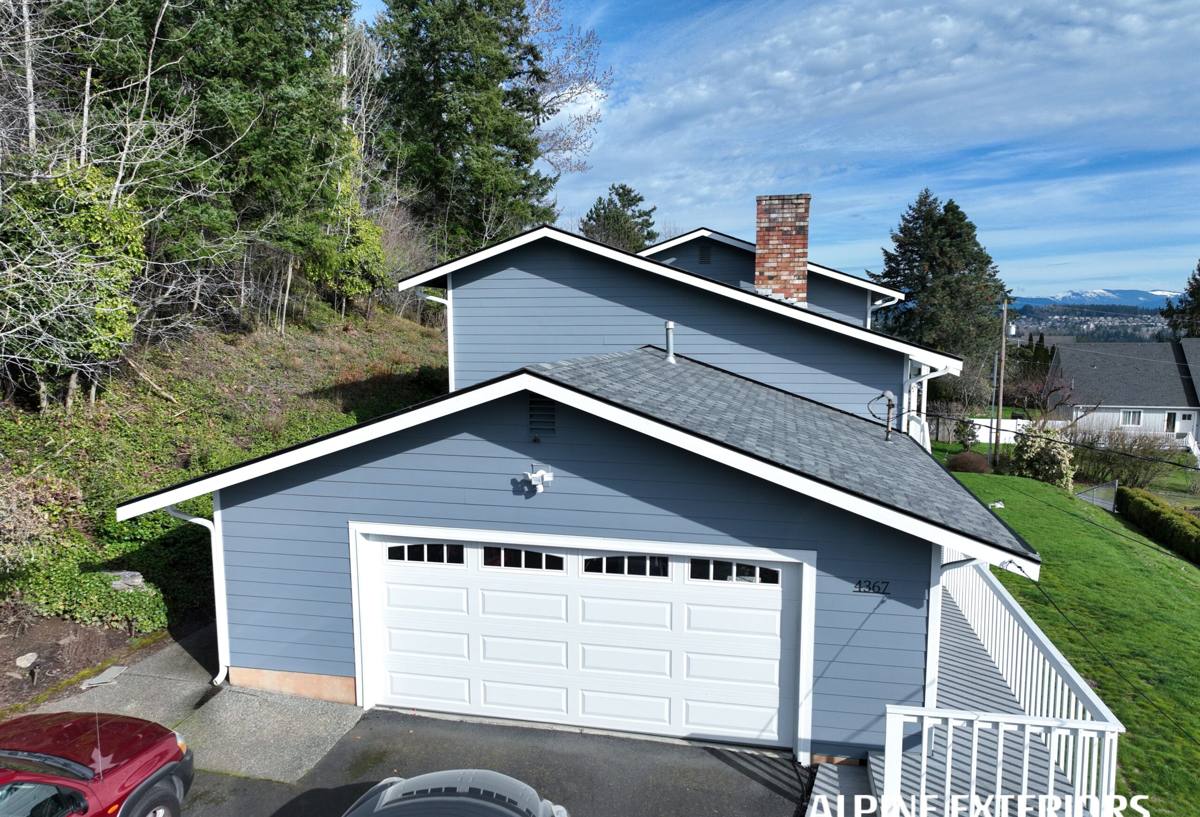
What Sudden Valley Homes Face Year-Round
Whatcom County's marine climate is mild compared to a lot of the country, but "mild" doesn't mean easy on building materials. The combination of near-constant humidity, driving rain off the Pacific weather systems, and a marine air layer that carries a faint salt content even well inland adds up to a slow, steady wear pattern most homeowners don't notice until it shows up as a soft spot or a foggy pane.
Moss and Algae Season
In this part of Whatcom County, moss and algae growth isn't a summer problem — it's basically a year-round one, with the heaviest growth from fall through spring when things stay damp for weeks at a time. On windows specifically, this shows up less as green fuzz on the glass and more as dark streaking at the sill, black growth in corners that don't get sun or airflow, and a slow buildup of organic debris in the tracks of sliding sashes. Left alone, that moisture-holding buildup is what eventually gets into the wood or composite underneath the finish.
Wind-Driven Rain and Seal Fatigue
Storms coming off the lake and through the valley don't just drop rain straight down — they push it sideways into window faces, especially on the west- and south-facing walls of a house. That kind of driving rain finds any weakness in a seal or flashing detail far faster than a light, straight-down rain would. Over years, it's usually the reason a window that "looked fine" starts showing a fogged double-pane unit or a soft spot in the sill.
Signs Your Windows Are Losing the Battle
Most window failure is gradual, so it helps to know what to actually look for before it becomes a bigger repair. Walk your exterior on a wet day if you can — problems are more obvious when everything is saturated.
- Fogging or a milky haze between panes (means the seal on a double- or triple-pane unit has failed)
- Soft, spongy, or discolored wood at the sill or lower frame corners
- Visible black or green growth in the tracks or corners that doesn't wipe off easily
- Drafts you can feel near the frame even with the window fully latched
- Difficulty opening, closing, or latching a window that used to operate smoothly
- Paint or finish that's peeling, bubbling, or chalking specifically around the window opening, not the wall
- Condensation forming on the inside of the glass regularly during cold snaps
Any one of these on its own might just mean a repair. Several of them together, especially on the same window, usually mean it's time to talk about replacement.
Window Materials: What Actually Holds Up Here
There's no single "best" window material — it depends on the exposure, the budget, and how much upkeep you want to take on. Here's how the common options compare for a climate like ours.
| Material | Moisture Performance | Maintenance | Typical Fit |
|---|---|---|---|
| Vinyl | Doesn't rot or corrode; seals are the main wear point | Low — occasional cleaning, no repainting | Most budget-conscious full replacements |
| Fiberglass | Very stable in wet/dry cycling, holds paint well if painted | Low to moderate | Higher-exposure walls, longer-term ownership |
| Wood (unclad) | Attractive but vulnerable to prolonged moisture without diligent upkeep | High — regular finish maintenance required | Historic or architecturally specific homes only |
| Wood-clad / composite | Cladding protects the exterior face; interior wood stays dry-side | Moderate | Homes wanting a wood interior look with better exterior durability |
For most Yew Street homes, we lean toward vinyl or fiberglass on the weather-exposed elevations simply because they hold up to sustained moisture exposure with the least amount of homeowner upkeep. We'll still install wood or wood-clad where it matches the house's character — we just make sure you understand the maintenance commitment that comes with it, rather than letting that trade-off surprise you five years in.
Repair or Replace? What Actually Drives That Decision
We don't push replacement when a repair will genuinely hold. The honest factors that tip the decision one way or the other:
| Factor | Leans Toward Repair | Leans Toward Replacement |
|---|---|---|
| Seal failure | Single unit, frame otherwise sound | Multiple units failing, or frame has moisture damage too |
| Frame condition | Solid, cosmetic wear only | Soft wood, visible rot, or corrosion at hardware points |
| Operation | Sticks but functions with adjustment | Won't latch, won't stay open, or hardware is stripped |
| Energy performance | Recent, code-era window with a localized issue | Older single-pane or early double-pane unit, noticeable drafts |
| Timeline | Isolated problem, house otherwise stable | Part of a broader exterior refresh already planned |
If you're already planning other exterior work — new siding, a roof replacement, a deck rebuild — it's often worth timing window replacement alongside it. That avoids redoing flashing or trim details twice and usually saves on labor overlap.
How We Approach Installation
Window failure in this climate is rarely about the window unit itself — it's almost always about the flashing, the sill pan, and how the opening ties into the surrounding wall assembly. A quality window installed with poor flashing details will fail early. A modest window installed correctly will often outlast a premium one that wasn't.
Our process on a typical replacement:
- Remove the old unit and inspect the rough opening for hidden moisture damage before anything new goes in
- Repair or rebuild any soft framing or sheathing we find — we don't box a new window into a compromised opening
- Install a proper sill pan and flashing sequence that sheds water outward, not into the wall cavity
- Set and shim the window plumb, level, and square, then seal per manufacturer specification
- Finish trim and touch-up so the new window matches the surrounding siding or trim detail
That opening-and-flashing step is the one that gets skipped by crews trying to move fast, and it's the one that determines whether the window is still performing in fifteen years or fogging up again in five.
Windows Are Part of a Bigger Exterior System
We work on siding, roofing, windows, and decks, and on a house like the ones along Yew Street, those systems are more connected than they look. Window trim ties directly into siding flashing. A roof edge that's shedding water badly can dump extra volume onto upper-story windows below it. A deck built too close to a window wall can trap moisture against the siding and the window trim alike. When we're on-site for a window job, we'll flag anything nearby that's contributing to the problem — not to upsell you, but because fixing the window while ignoring the roof detail dumping water on it just means you're back here again in a couple of years.
Why a Local Crew Matters for This Neighborhood
Sudden Valley isn't a generic subdivision — it has its own topography, tree cover, and microclimate driven by the lake, and homes here were built across different decades with different construction standards. A crew that works this specific area regularly knows which elevations on a typical Yew Street lot take the worst of the winter storms, what the common window brands and installation shortcuts from certain building eras tend to look like once opened up, and how to get material and equipment in and out of the community efficiently. That familiarity shows up in fewer surprises once a wall is opened and a more accurate estimate up front.
Maintenance That Actually Extends Window Life
A little seasonal attention goes a long way in this climate:
- Clean window tracks and weep holes each fall before the heavy rains set in
- Wipe down sills periodically through the wet months to keep moss and algae from getting a foothold
- Check exterior caulking annually — Whatcom County's wet-dry cycling breaks down sealant faster than a drier climate would
- Keep nearby trees and shrubs trimmed back so window walls get some airflow and sun exposure
- Address small drafts or sticking sashes early, before they turn into frame damage
If you're noticing any of the issues above, or you're just planning ahead for an aging set of windows, we're happy to take a look and give you a straightforward, no-pressure estimate. There's a form below — tell us a bit about your home on Yew Street and we'll go from there.