 Sudden Valley Window
 Composite Decking in Sehome: Why the Material Matters Here
A deck in Sehome doesn't fail the way a deck fails in a dry climate. Out here, the enemy isn't one hard freeze or one hot summer — it's months of steady moisture, salt-tinged air moving up from the water, and a moss season that can run from October well into April. Composite decking exists specifically to shrug off that combination, but only when it's specified and installed correctly for the conditions it's actually going to sit in. That's the piece that gets skipped most often, and it's the piece that determines whether a deck looks good for two years or twenty.
Sudden Valley Window Co has spent years working exteriors throughout Whatcom County, and decks built in the Sehome area see a specific pattern of wear: boards that cup or crown where drainage was ignored, fasteners that streak or loosen where the wrong hardware was used, and green-black growth in shaded, low-airflow sections that never get a chance to dry out between storms. None of that is a flaw in composite decking as a product. It's what happens when a deck is installed to a generic spec instead of a local one.
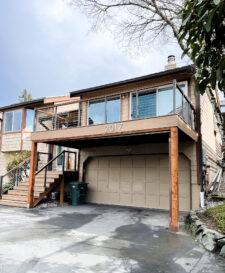
What Driving Rain and Salt Air Actually Do to a Deck
Two climate factors drive almost every decking problem we see in this part of Whatcom County:
Driving rain
Wind-driven rain doesn't just fall on a deck — it gets pushed sideways into joints, under boards, and into any gap where flashing or spacing was cut short. Composite boards themselves don't absorb water the way wood does, but the substructure underneath them still can, and standing water trapped between boards and joists is what eventually rots framing, corrodes fasteners, and causes the deck surface to telegraph problems from below.
Salt air
Proximity to the water means airborne salt settles on every exterior surface, including decking hardware. Over time, salt exposure accelerates corrosion on lower-grade screws, clips, and joist hangers. It also interacts with algae and moss growth — salt-laden moisture keeps surfaces damp longer, which extends the window for organic growth to take hold.
Composite decking resists rot and doesn't need annual sealing the way wood does, but it isn't maintenance-free, and it isn't immune to bad installation choices. The board is only as good as the frame, fasteners, and drainage plan underneath it.
Composite vs. Wood vs. PVC: An Honest Comparison for This Climate
| Factor | Wood | Composite | PVC / Capped Polymer |
|---|---|---|---|
| Moisture resistance | Low — absorbs water, needs regular sealing | High — engineered to shed moisture | Very high — fully synthetic |
| Moss/mildew resistance | Poor in shaded, damp areas | Good, especially capped boards | Very good |
| Upfront cost | Lowest | Mid-range | Highest |
| Long-term upkeep | Annual sealing/staining | Occasional cleaning | Minimal cleaning |
| Feel underfoot in heat/cold | Natural, can splinter over time | Consistent, some heat retention | Consistent, engineered for stability |
| Fastener/hardware sensitivity | Moderate | Higher — spacing and clips matter | Higher — manufacturer specs are strict |
For most homes in the Sehome area, composite strikes the practical middle: it handles our rain and salt exposure far better than untreated or even sealed wood, without the premium cost of full PVC systems. We'll talk through where PVC makes sense — heavily shaded decks, waterfront-adjacent properties, or homeowners who want the lowest possible maintenance — during the estimate, rather than defaulting to one product for every job.
What a Correct Composite Installation Actually Involves
The board brand matters less than most homeowners think. What matters more is what happens before a single composite board goes down:
Framing and joist spacing
Composite boards flex differently than wood and generally require tighter joist spacing than a traditional wood deck, especially at angles or picture-frame borders. Framing built to wood-deck spacing under composite boards is one of the most common causes of bounce and long-term sag.
Drainage and airflow underneath
In a climate with this much rainfall, the space under the deck needs a real path for water and air to move. That means correct joist tape application, gapping between boards for expansion and drainage, and — on lower decks close to grade — attention to how water sheets off and where it goes, so it isn't sitting against ledger boards or foundation walls.
Fasteners and hardware
Coastal-grade, corrosion-resistant fasteners and hidden fastening clips rated for the specific board profile are non-negotiable here. Mismatched or budget hardware is often the first thing to fail, well before the decking material itself shows any wear.
Ledger attachment and flashing
Where the deck ties into the house, flashing has to be detailed to shed water away from the wall assembly, not just sit as a token strip. This is the single most common point of hidden water intrusion on attached decks in wet climates.
Installation checklist we work from on every composite deck
- Joist spacing confirmed against the specific board manufacturer's requirements
- Ledger flashing installed and integrated with existing wall drainage, not just caulked
- Corrosion-resistant, board-rated fasteners or hidden clips used throughout
- Board gapping set for both drainage and thermal expansion
- Joist tape applied to protect framing lumber from trapped moisture
- Airflow path confirmed underneath low or skirted decks
- Stair stringers and rail posts checked for the same fastener and flashing standards as the deck field
Moss, Mildew, and Realistic Long-Term Maintenance
Composite decking greatly reduces maintenance compared to wood, but "low-maintenance" isn't "no-maintenance" in a climate with a moss season this long. Shaded corners, areas under overhangs that don't get direct sun or wind, and spots where leaves and debris collect are still going to develop surface growth if they're never cleaned. The difference with a properly installed composite deck is that this growth sits on the surface rather than working its way into the wood grain, so routine cleaning — a stiff brush, mild soap, occasional pressure washing at a safe distance and pressure setting — actually solves the problem instead of just masking it.
Decks with poor drainage or tight board gapping tend to hold onto moss longer because the boards themselves stay damp between rain events. That's another reason the installation details matter as much as the product choice.
How We Approach a Composite Deck Project
- On-site assessment. We look at sun exposure, existing drainage, ledger condition, and how exposed the site is to wind-driven rain and salt air before recommending a board tier or system.
- Honest product recommendation. We'll walk through composite and PVC options with real trade-offs — cost, appearance, maintenance — rather than pushing one line because it's what we have on the truck.
- Framing and drainage plan. Joist layout, flashing detail, and airflow are specified before materials are ordered, not improvised on install day.
- Installation. Built to manufacturer spacing and fastening requirements, with attention to the ledger connection and any low-clearance drainage points.
- Walkthrough. We go over basic care — cleaning frequency, what to keep off the boards, how to spot early drainage issues — so the deck actually gets the lifespan it's built for.
Why a Crew That Already Works This Area Matters
A deck built to a generic national spec sheet can still fail in a coastal Whatcom County microclimate if it doesn't account for how much water this area actually sees and how long things stay damp between dry spells. Sudden Valley Window Co works exteriors across Sudden Valley and the greater Bellingham area, including Sehome, and that regular exposure to the same weather pattern is what shapes decisions like joist spacing, hardware grade, and drainage detailing on every deck we build. It's less about brand loyalty to one composite manufacturer and more about knowing which installation details actually matter once the rain starts and doesn't let up.
What Composite Decking Costs Depend On
| Cost Factor | Why It Matters |
|---|---|
| Board tier (capped vs. capped composite vs. PVC) | Higher-tier boards cost more upfront but generally need less cleaning and resist fading and moisture longer |
| Deck size and shape | Cutouts, angles, and picture-frame borders add labor and material waste |
| Substructure condition | Existing framing that needs repair or replacement adds cost before decking even starts |
| Railing and stair systems | Composite or metal rail systems vary widely in price and installation time |
| Site access and grade | Low-clearance or hard-to-access sites take longer to properly ventilate and drain |
We give exact numbers only after seeing the site — anyone quoting a firm price over the phone for decking is skipping the assessment that actually determines cost.
Questions Worth Asking Before You Sign a Decking Contract
- What joist spacing will you use, and does it match this specific board's requirements?
- What fastener or clip system is included, and is it corrosion-resistant?
- How will you flash and drain the ledger connection to the house?
- What's the plan for airflow underneath the deck if it sits low to grade?
- What does routine maintenance actually look like for the specific product you're installing?
If a contractor can't answer these clearly, it's worth getting a second opinion before work starts — these are the details that separate a deck that lasts from one that needs rework in a few wet seasons.
If you're weighing composite decking for a home in the Sehome area, we're happy to walk the site, look at drainage and sun exposure, and give you a straight answer on what it would take — no pressure, no obligation. The form below gets you a free estimate.