 Sudden Valley Window
 Why Happy Valley Homes Need a Different Approach to Energy-Efficient Windows
Homes in and around Happy Valley deal with a climate that's harder on windows than most manufacturers' warranty language admits. You've got moisture coming from three directions at once: driving rain off the water, humid air that sits in the trees and never fully dries out, and the kind of long gray stretch from October through April where a window frame might not see direct sun for weeks. Add in salt-laden air moving inland from the Sound and Whatcom County's notorious moss season, and you have a set of conditions that will find every weak point in a window assembly — the seal, the flashing, the frame material, all of it.
"Energy-efficient" gets used as a marketing word a lot. For a Happy Valley home, it should mean something more specific: a window that keeps its seal intact through repeated wet-dry cycles, resists moss and mildew buildup on sills and tracks, and actually holds its rated performance five and ten years in — not just on the day it's installed. That's the standard we build every job around.
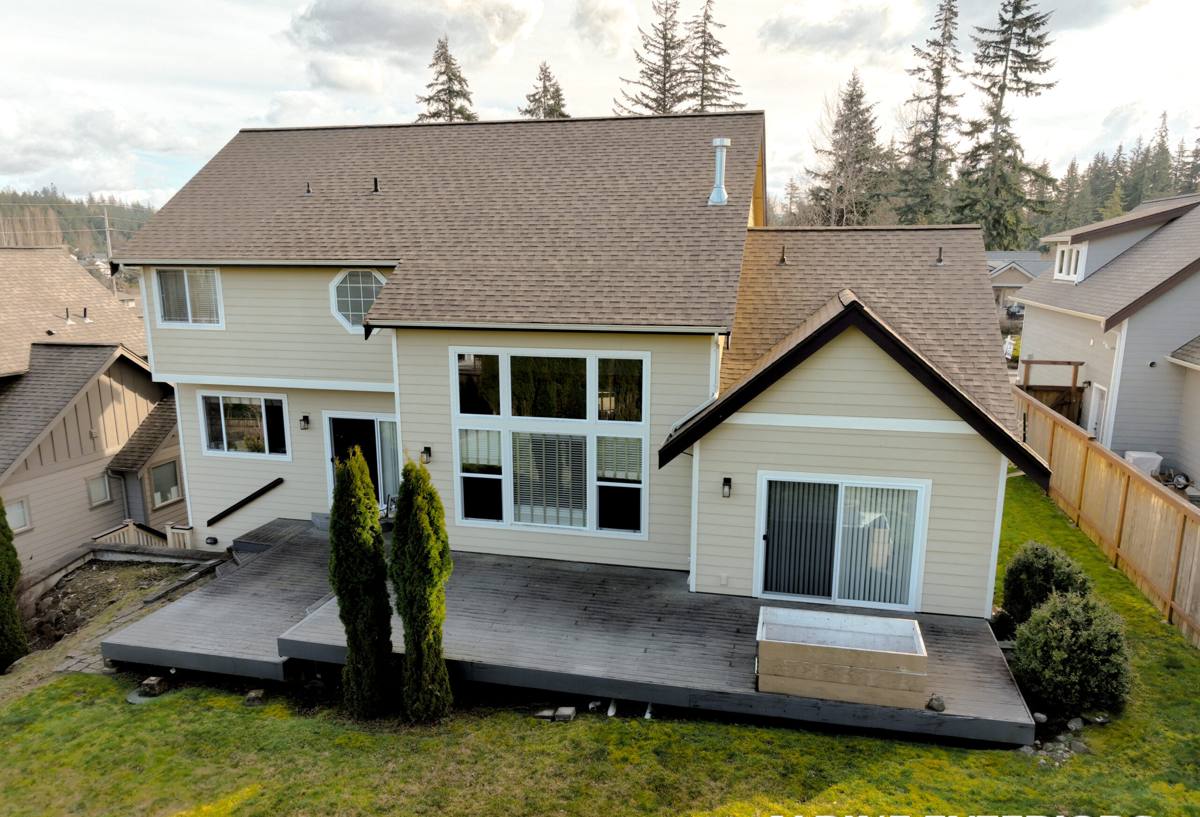
What the Regional Climate Actually Does to a Window Over Time
Driving Rain and Wind-Driven Moisture
Wind-driven rain doesn't fall straight down — it gets pushed sideways into wall assemblies, and windows are the weakest point in that wall. If flashing and sill pans aren't detailed correctly, water gets behind the frame instead of running off it. That's when you start seeing soft trim, stained drywall below a window, or a musty smell in a room that otherwise seems fine.
Salt Air and Metal Fatigue
Salt in the air accelerates corrosion on hardware — hinges, locks, balance mechanisms, and any exposed fasteners. Aluminum cladding and lower-grade hardware show pitting and stiff operation years before an equivalent window would fail inland. This is one of the reasons hardware selection matters as much as the glass package.
Moss Season and Sill Buildup
Whatcom County's moss season isn't just a roof problem. Moss and algae take hold on horizontal window sills, tracks, and any place where wood or composite material stays damp for extended periods. Left alone, it holds moisture against the frame year-round and shortens the life of caulking, weatherstripping, and paint or finish.
What a Correct Energy-Efficient Window Job Actually Involves
A lot of window jobs look fine for the first year and then start failing at the two- to five-year mark. That's almost always an installation issue, not a product issue. Here's what we consider non-negotiable on every job:
- Removing old windows down to the rough opening and inspecting the framing for hidden rot before anything new goes in
- Correct sill pan flashing so any water that does get past the window sheds outward, not into the wall cavity
- Properly lapped weather-resistive barrier integration around the new unit — shingled so water always moves down and out
- Low-expansion foam or backer rod and sealant at the right points — not foam everywhere, which can bow frames out of square
- Shimming and fastening per the window manufacturer's instructions so the sash operates true and the seals compress evenly
- Interior and exterior sealant beads sized and placed correctly — gaps here are a direct path for moisture and air leakage
Skip any one of these and the window's U-factor and air-infiltration numbers on paper stop meaning much in practice.
Choosing the Right Window Material for This Climate
Material choice matters more here than in a drier inland climate, because the frame is fighting moisture exposure every month of the year, not just in a wet season.
| Material | Moisture Resistance | Maintenance | Typical Lifespan |
|---|---|---|---|
| Vinyl | Very good — won't rot, low porosity | Low — occasional cleaning | 20–30+ years |
| Fiberglass | Excellent — dimensionally stable, resists warping | Low | 30–40+ years |
| Wood-clad | Good exterior, vulnerable if cladding is breached | Higher — periodic sealant/paint checks | 20–30 years with upkeep |
| Aluminum | Poor thermal performance, prone to condensation and pitting near salt air | Moderate | Varies widely |
We don't push wood-clad windows on homes close to the water in this area as a first recommendation. It's not that the product is bad — it's that any breach in the cladding, however small, lets moisture into a wood core that then has nowhere to dry out in this climate. Vinyl and fiberglass carry that risk far less, which is why they make up most of what we install locally. If a homeowner wants the look of wood-clad for a specific architectural reason, we'll install it — but we walk through the added maintenance commitment first so there are no surprises later.
Glass Packages and Performance Numbers Worth Actually Understanding
Two numbers matter more than any marketing claim on the box: U-factor (how much heat escapes — lower is better) and Solar Heat Gain Coefficient, or SHGC (how much solar heat passes through — lower is generally better for a climate with mild summers and long heating seasons). For this region, we typically steer homeowners toward a low U-factor, moderate-to-low SHGC double or triple-pane unit with a warm-edge spacer system. Warm-edge spacers matter here specifically because they reduce the cold-edge condensation that shows up as fogging or moisture beading on interior glass during the wettest months — a common complaint we hear from homes with older aluminum-spacer windows.
Argon vs. Krypton Fill
Argon gas fill is standard and cost-effective for most window sizes. Krypton performs slightly better in narrow gas spaces (like some triple-pane or slim-profile units) but costs more and isn't necessary for the majority of standard residential window sizes.
Our Process for a Happy Valley Window Replacement
- On-site assessment — we look at existing window condition, framing, orientation (south/west-facing units take more weather and sun), and any signs of past moisture intrusion.
- Product recommendation — matched to the specific wall and exposure, not a one-size answer for the whole house.
- Written proposal — clear on materials, glass package, and what the flashing/sealing scope includes.
- Removal and rough opening inspection — this is where hidden rot or past water damage gets caught before it's covered up again.
- Installation with proper flashing and sealing — per manufacturer spec, not shortcuts.
- Final check — operation, seal, and cleanup, with a walk-through so you know what to expect from the new windows.
Cost Factors Homeowners Should Understand Up Front
| Factor | Why It Moves the Price |
|---|---|
| Window count and size | Larger openings and full-house jobs have per-unit efficiencies vs. single replacements |
| Frame condition | Rot repair or reframing adds labor and material beyond the window itself |
| Glass package | Double vs. triple pane, low-E coatings, and gas fill all shift unit cost |
| Access and second-story work | Staging or lift access for upper-floor windows adds labor time |
| Trim and finish work | Matching existing interior/exterior trim can add scope beyond a stock install |
We won't quote a whole-house number over the phone without seeing the openings — anyone who does that is guessing, and on a home dealing with this much moisture exposure, guessing is how surprise costs show up mid-job.
What to Ask Before Hiring Anyone for This Work
- Do you inspect the rough opening for rot before installing, or just swap the window in place?
- What flashing method do you use, and can you explain why?
- Are you licensed and insured to do exterior work in Washington?
- What's the warranty on both the product and your labor, separately?
- Have you worked on homes in this specific area before, and do you understand the moisture and salt exposure here?
- Will you put the glass package specs (U-factor, SHGC) in writing?
A contractor who's worked Happy Valley and the broader Sudden Valley area before will answer these without hesitation, because they've already run into the rot, the moss, and the salt-air hardware wear firsthand. That local track record is worth more than a lower bid from a crew that treats every job as generic.
After Installation: Keeping Windows Performing in This Climate
Energy-efficient windows aren't maintenance-free here, even though they're low-maintenance compared to older wood units. A few habits keep them performing at their rated efficiency:
- Clear moss and debris from sills and tracks each fall before the wet season sets in
- Check exterior caulking annually for cracking or separation, especially on south- and west-facing units
- Operate hardware periodically through the winter so mechanisms don't seize from disuse and moisture
- Watch for condensation between panes — that indicates a failed seal, not a cleaning issue
If you're weighing whether to repair or replace, we're glad to take a look and give you a straight answer — including telling you when a window doesn't need replacing yet. We'd rather earn the next job than push work that isn't needed.
If you're in Happy Valley or anywhere around Sudden Valley and want a clear, no-pressure look at your windows, use the form below for a free estimate. We'll walk the exterior, check what's actually going on, and give you honest options.