 Sudden Valley Window
 Fairhaven's Siding Problem Isn't Like Everywhere Else
Homes near Fairhaven deal with a specific combination of punishment: salt-laden air off the water, wind-driven rain that hits walls sideways instead of straight down, and a long stretch of the year when shaded and north-facing walls simply stay damp. Any one of those is manageable. Together, over years, they expose every weak point in a siding system — seams that weren't sealed right, paint that wasn't formulated for the coastal air, or a wood-based product that was never meant to stay wet this often. If you're pricing siding for a Fairhaven-area home, the climate should shape almost every decision, not just the color you pick.
We work on homes throughout the Sudden Valley and Whatcom County area, and Fairhaven's exposure is on the tougher end of what we see. That's not a reason to overbuild or overspend — it's a reason to be precise about material choice and installation detail, because the margin for error is smaller here than it is a few miles inland.
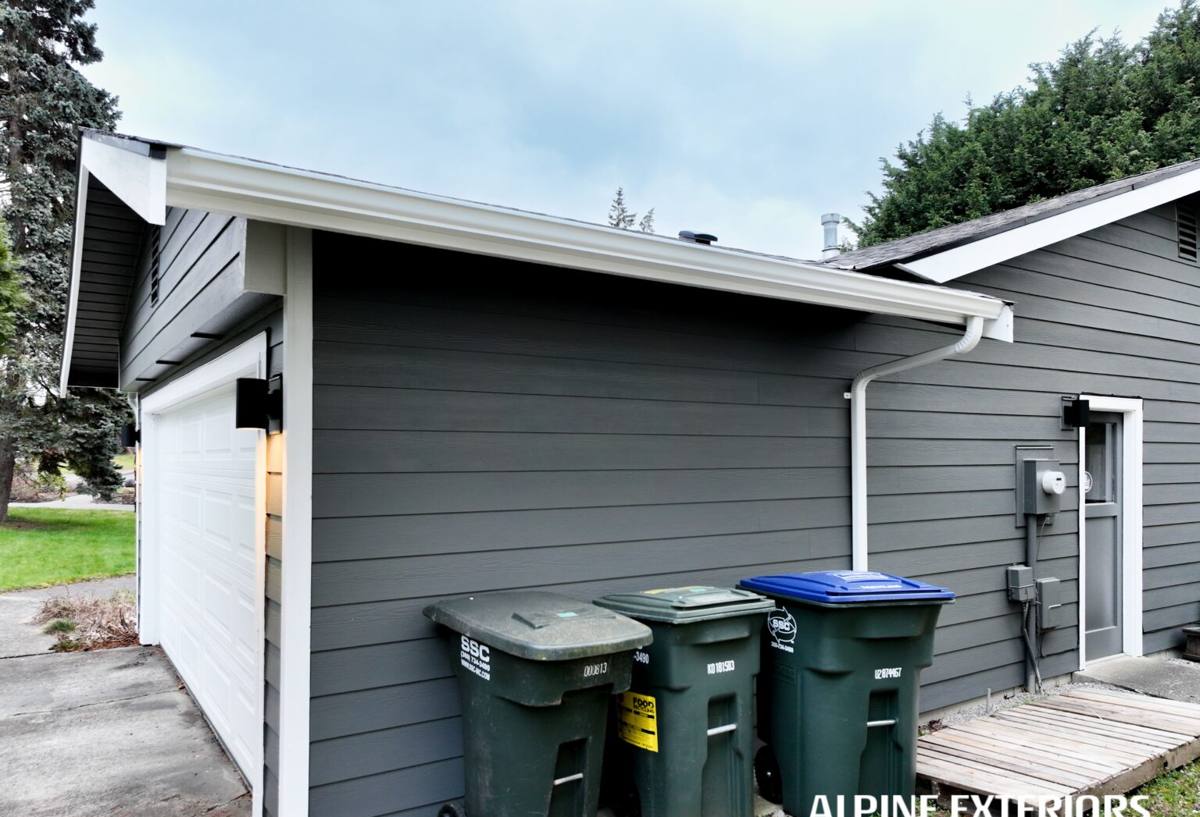
What Salt Air, Driving Rain, and Moss Season Do to a Wall
Salt air
Airborne salt is corrosive to metal fasteners, flashing, and trim, and it accelerates the breakdown of lower-grade paint films. Siding that isn't chemically stable near the coast will chalk, fade unevenly, or lose adhesion at the surface faster than the same product would inland.
Driving rain
Wind off the water doesn't just wet a wall — it drives water sideways and upward, forcing moisture into laps, joints, and any gap in the water-resistive barrier behind the siding. A siding system with poor moisture tolerance, or an installation with undersized clearances and gaps, will take on water at exactly these points.
Moss season
Whatcom County's wet season runs long, and shaded walls under trees or on the north side of a house can stay damp for weeks at a stretch. Moss and algae aren't just cosmetic — the biological growth holds moisture against the surface and, on products that can absorb water, keeps that section of wall wet far longer than it should be.
What a Correct Fiber Cement Job Requires Here
Given that combination of exposures, a fiber cement siding job for a Fairhaven-area home needs to get several things right that a milder climate might forgive:
- Correct clearances — siding held off decks, patios, and grade by the manufacturer's minimum gap, so splash-back and standing water don't sit against the bottom edge.
- Sealed and flashed penetrations — every window, vent, hose bib, and light fixture needs proper flashing and sealant compatible with fiber cement, not just a bead of caulk.
- Corrosion-resistant fasteners — stainless or coated fasteners rated for coastal exposure, not standard galvanized nails that will eventually bleed rust through the finish.
- A functioning water-resistive barrier and rainscreen detail — a drainage plane behind the siding so any moisture that does get past the cladding has somewhere to go.
- Factory-finished color, not field-painted — a factory finish cures under controlled conditions and holds up to UV and salt exposure far better than a coat applied on site.
Skip any one of these and the siding itself can be excellent and the wall will still fail early. Installation detail is at least as important as the product on the truck.
Why We Only Install James Hardie Fiber Cement
We don't install vinyl, LP SmartSide, primed spruce, cedar, or off-brand fiber cement like Cemplank or Allura. That's a deliberate standard, not a sales pitch, and it's worth explaining plainly.
Vinyl is inexpensive and low-maintenance, but it's a petroleum-based product that can warp in heat and become brittle in cold, and it relies entirely on caulking at seams and trim — caulking that has to be maintained forever in a climate this wet. Wood-based siding products (including engineered wood like LP SmartSide, and natural cedar) perform fine when kept dry and maintained on schedule, but a coastal, high-moisture, long-moss-season environment is exactly the condition that wood-based products struggle with over time: they can swell, delaminate at cut edges, or take on moisture faster than they release it. Off-brand fiber cement products can be reasonable materials, but we don't have the same confidence in their engineering, quality control, or long-term warranty backing that we have in Hardie, and we'd rather stand behind one system we know cold than install several we're less sure of.
James Hardie fiber cement is non-combustible, dimensionally stable in wet-dry cycling, and comes with a factory-applied ColorPlus finish designed to resist fading and chalking without repainting for years. It's also engineered in climate-specific formulations — which matters directly for a place like Fairhaven.
HZ Product Engineering
Hardie manufactures its siding in different HZ (HardieZone) formulations tuned to regional climate — moisture, freeze-thaw, and humidity conditions vary a lot across the country, and the product is engineered differently for each zone rather than sold as one universal formula. For a Pacific Northwest coastal climate like Fairhaven's, that means a product line built around sustained moisture exposure, not one optimized for a dry or freeze-heavy region. This is one of the practical reasons we standardized on Hardie: the product itself is already built for conditions like ours, before installation detail even comes into play.
Our Process for a Fairhaven-Area Siding Job
The work follows the same sequence on every job, because skipping steps is where coastal siding failures usually start.
- Walk and assess. We look at the existing wall assembly, moisture history, trim condition, and any problem areas — shaded sides, low clearance spots, past water staining — before quoting anything.
- Tear-off and sheathing check. Old siding comes off and we inspect the sheathing underneath for rot or soft spots. Anything compromised gets repaired before new siding goes on; covering up existing damage is how small problems become expensive ones.
- Water-resistive barrier and rainscreen. A new weather barrier goes on with proper lapping and taped seams, and we build in a drainage gap so moisture that reaches the back of the siding can drain and dry instead of sitting against the wall.
- Flashing at every penetration. Windows, doors, vents, and fixtures get flashed to shed water outward, not sealant alone.
- Hardie installation to manufacturer spec. Correct nailing pattern, correct clearances from grade and roofing, correct fastener type for coastal exposure.
- Trim, caulking, and final inspection. We walk every joint and penetration before calling the job done.
Job-Readiness Checklist for Homeowners
- Ask what's happening with the sheathing underneath, not just the new siding on top.
- Confirm the clearance from grade, decks, and roofing meets Hardie's published minimums.
- Ask what fastener type is being used and whether it's rated for coastal exposure.
- Confirm a drainage gap or rainscreen detail is part of the installation, not just a barrier.
- Get the specific Hardie product line and color in writing, not just "fiber cement siding."
Cost Factors for Fairhaven-Area Siding Projects
Every home is different, but the same handful of factors drive most of the cost variation we see on jobs in this area:
| Factor | Why It Matters Here |
|---|---|
| Wall condition underneath | Hidden rot from long-term moisture exposure adds repair work before siding can go on |
| Home exposure | Walls facing the water or prevailing wind need more careful detailing than sheltered walls |
| Trim and detail complexity | Dormers, bays, and multiple roof lines mean more flashing and cut work |
| Access and site conditions | Slopes, tight lots, and mature landscaping affect staging and scaffolding |
| Product line and profile | Lap, shingle, and panel profiles carry different material and labor costs |
We give a firm, itemized quote after the initial walk-through — not a rough guess based on square footage alone, because on a coastal wall the condition underneath often matters more than the size of the job.
Why Hiring a Crew That Already Works Fairhaven Matters
Coastal and near-coastal siding work has a learning curve that's easy to underestimate. A crew that mostly works drier, inland jobs can install a technically correct system and still miss the details that matter most in a place like Fairhaven — because those details simply don't come up as often anywhere else. A crew that regularly works this area already knows which walls take the worst weather, how long moss season actually runs, and where clearance and flashing mistakes tend to show up first. That local pattern-recognition is hard to replace with a manual, and it's the difference between a siding job that looks right on install day and one that's still performing correctly in year ten.
Maintenance After Installation
A correctly installed Hardie system is genuinely low-maintenance, but "low" isn't "none," especially in this climate:
- Rinse siding periodically to clear salt residue and organic buildup, particularly on shaded or coastal-facing walls.
- Keep gutters and downspouts clear so water isn't dumping directly onto siding or pooling at the base of a wall.
- Inspect caulking at trim and penetrations every year or two and re-caulk as needed — the siding itself may outlast the sealant.
- Trim back vegetation that keeps a wall shaded and damp longer than it needs to be.
Get a Straight Answer for Your Home
If you're planning a siding project near Fairhaven, we're happy to take a look and give you an honest read on what your home actually needs — no pressure, no upsell to a product we don't stand behind. Reach out for a free estimate using the form below.