 Sudden Valley Window
 Siding on Lake Whatcom: A Different Set of Problems Than a Typical Whatcom County Lot
Lake Whatcom is one of the more demanding places to keep siding looking and performing well in Whatcom County. Homes here sit close to open water, often tucked under tree cover on sloped, irregular lots, and they take on a mix of exposures that a house a few miles inland simply doesn't deal with. We install fiber cement siding for homes in and around Lake Whatcom, including the Sudden Valley community on its south shore, and the approach we use here is built around what actually survives this specific environment — not a generic siding pitch.
We install James Hardie fiber cement siding exclusively. That's a professional standard, not a supplier arrangement, and it's rooted in what we consistently find when we tear old siding off lake-adjacent homes: materials that can't handle sustained moisture and shade fail years before they should, while a properly installed fiber cement system keeps performing.
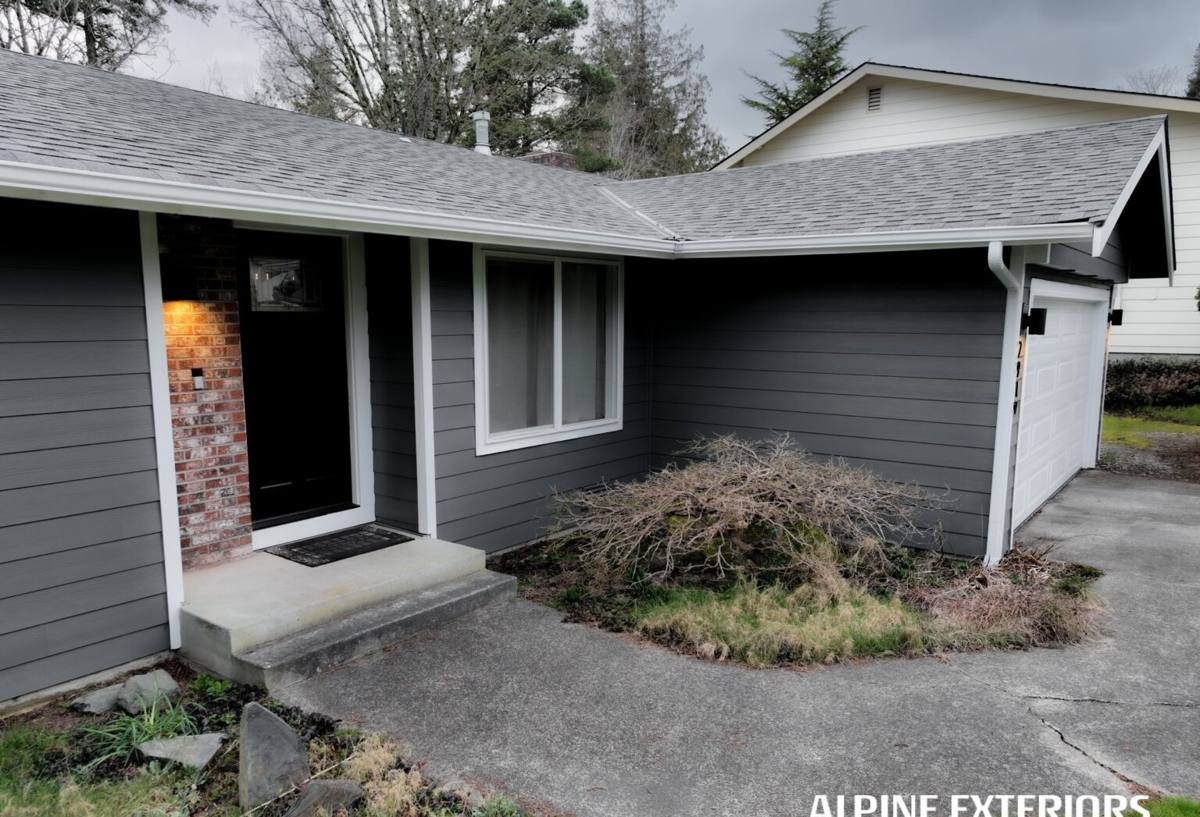
What Lake Whatcom's Climate Does to Exterior Siding
Salt Air and Airborne Moisture
Lake Whatcom isn't salt water, but homes close to any large body of water deal with persistently higher humidity and airborne moisture than inland properties, and that moisture load settles on siding, trim, and fasteners day after day. Materials that rely on periodic full drying to stay stable don't get that break near the lake. Paint finishes chalk and fade faster, seams and joints stay damp longer, and any material with a wood or wood-composite base has more opportunity to absorb moisture than it would a few miles away from open water.
Driving Rain Off the Lake
Wind moving across open water picks up speed and drives rain directly into lake-facing walls with more force than a sheltered inland elevation ever sees. Combine that with the hilly, wooded terrain around Lake Whatcom — homes here sit at a range of elevations and orientations relative to the water — and you get siding exposure that varies dramatically from one wall of the same house to the next. Flashing, joint sealing, and water-shedding details need to be built for the worst-exposed wall, not an average condition, or the lake-facing side of the house will show problems long before the rest of it does.
A Long Moss Season
Shade from surrounding tree cover, cool temperatures, and near-constant humidity off the lake add up to a moss and mildew season that runs most of the year in this part of Whatcom County. Roofs usually show it first, but siding isn't immune — porous or moisture-retentive materials pick up green and black staining in shaded corners and under eaves, and once established, moss and mildew hold moisture directly against the siding surface, which accelerates whatever degradation was already underway.
Why We Install Only James Hardie Fiber Cement Here
We don't offer a menu of siding brands. On Lake Whatcom specifically, we've made the call to install one system and stand behind it completely, because we've seen what a mix of salt air, driving rain, and a long moss season does to materials that weren't built for sustained moisture exposure.
- Non-combustible core: Fiber cement doesn't feed a fire the way wood-based siding can, which matters given how much of the Lake Whatcom shoreline sits inside or adjacent to tree cover.
- Factory-applied ColorPlus finish: The finish is baked on at the factory rather than brushed on at the house, and it holds up against fading and moisture intrusion far longer than field-applied paint on a wall that rarely gets a full day of direct sun.
- Climate-engineered HZ product lines: Hardie's HZ5 formulation is built for regions with sustained moisture exposure and freeze-thaw cycling, which matches Lake Whatcom's combination of humidity, shade, and winter temperature swings.
- Dimensional stability: Fiber cement doesn't swell, cup, or warp the way engineered wood siding can after repeated wetting cycles that never fully resolve on a shaded, lake-facing wall.
- A strong transferable warranty: Hardie's warranty structure is one of the more substantial in the industry, provided the installation follows their published specifications — which is a real if-then, not a formality.
We won't install LP SmartSide, vinyl siding, Cemplank, Allura, primed spruce, or cedar. Each of those products has a legitimate place in the market and plenty of homeowners elsewhere are happy with them. On a lake-exposed property, though, we'd rather install one system correctly than offer a cheaper alternative that quietly shifts moisture risk and maintenance burden back onto the homeowner a few years down the road.
What a Correct Fiber Cement Installation Involves on This Site
Fiber cement only performs the way it's engineered to when the installation follows Hardie's published specifications exactly, and that matters more on a lake-facing wall than almost anywhere else in the county. A correct job includes:
- Correct fastener type, spacing, and embedment depth for the specific Hardie product being installed
- Proper clearance from grade, roof lines, decks, and any hardscape so water can't wick into the bottom edge of the siding
- A drainage plane or rain-screen detail behind the panels where the wall assembly calls for it, giving incidental moisture a path out instead of trapping it against the sheathing
- Properly sealed and back-primed cut edges at every joint, corner, and penetration
- Flashing at windows, doors, and roof-to-wall transitions sized and lapped for wind-driven rain, not just vertical rainfall
- Correct panel and joint layout on the lake-facing elevation specifically, since that's the wall carrying the most exposure
Skip any one of those details and the material itself won't save the wall. We've opened up enough lake-facing walls to know that a loosely installed premium product fails in the same places a cheap one does — moisture doesn't care what the siding is made of if it has a way in.
Our Process for a Lake Whatcom Siding Project
| Stage | What Happens | Why It Matters Here |
|---|---|---|
| Site walk and exposure assessment | We walk every elevation and note which walls take direct lake exposure, which sit under heavy shade, and where existing moisture or moss damage is already showing. | Lake Whatcom homes rarely have uniform exposure on all four sides — the plan has to match the actual conditions on each wall. |
| Tear-off and sheathing inspection | We remove the existing siding and check the sheathing and framing underneath for rot, soft spots, or prior water intrusion before anything new goes up. | Covering up existing moisture damage with new siding just hides the problem; it doesn't fix it. |
| Water management and drainage plane | We install or repair the weather-resistive barrier and drainage plane, with extra attention to flashing at windows, decks, and roof transitions on lake-facing walls. | This layer does the real waterproofing work — the siding is the second line of defense, not the first. |
| Hardie installation to spec | Panels or planks go up with the correct fastener schedule, clearances, and joint treatment for the specific product and exposure. | Warranty coverage and long-term performance both depend on installation matching Hardie's published requirements. |
| Final detailing and walkthrough | Caulking, touch-up, and trim work get finished, and we walk the finished job with the homeowner elevation by elevation. | Small gaps in caulking or trim are exactly where moisture starts working its way in on an exposed wall. |
Cost Factors Specific to a Lake Whatcom Property
Every siding quote depends on the size and complexity of the house, but a few factors come up more often on Lake Whatcom properties than they do elsewhere in the county:
| Factor | Why It Affects the Job |
|---|---|
| Access and slope | Many lake-area lots are steep or terraced, which affects staging, scaffolding, and how efficiently a crew can move material and equipment around the house. |
| Existing moisture damage | Homes that have gone years with a moisture-retentive siding product often need sheathing repair once the old material comes off, which isn't known until tear-off. |
| Drainage plane condition | If the existing weather-resistive barrier is intact and correctly lapped, it can sometimes be reused; if it's compromised, it has to be replaced as part of the job. |
| Number of exposures needing upgraded detailing | A home with one lake-facing wall needs less upgraded flashing work than one with two or three exposed elevations. |
| Trim and accessory scope | Fascia, soffit, and trim board condition often gets addressed at the same time as siding, since it's already open. |
We won't give a number without seeing the house — anyone who quotes lake-facing siding sight unseen is guessing, and guessing on this kind of exposure tends to show up later as a change order.
Signs Your Current Siding Is Already Losing the Fight
- Visible cupping, warping, or swelling along panel edges or seams
- Paint or finish that's chalking, peeling, or has faded unevenly between shaded and sun-exposed walls
- Soft spots when you press on siding near the bottom courses or around windows
- Persistent green or black staining that returns shortly after cleaning
- Visible gaps opening up at seams, corners, or trim joints
- Interior signs — staining, soft drywall, or a musty smell along an exterior wall, especially the lake-facing side
Any one of these on its own isn't necessarily an emergency, but on a lake-exposed wall they tend to compound quickly. Catching them early is the difference between a siding replacement and a siding-plus-sheathing replacement.
Why Local Experience on Lake Whatcom Specifically Matters
Whatcom County covers a lot of different microclimates, and a crew that mostly works dry, sheltered, in-town lots doesn't automatically know how to detail a lake-facing wall correctly. We work this shoreline regularly, which means we already know which elevations tend to take the worst of the wind-driven rain, where moss establishes first, and which existing installations in this area have held up and which haven't. That's not something a contractor can fully substitute with general experience alone — it comes from doing the work here, on this water, repeatedly.
It also affects scheduling and access. Lake-area lots are often steep, tree-covered, or have limited staging space, and a crew that's worked here before plans around that instead of discovering it on day one.
Get a Straight Answer on Your Siding
If your home sits on or near Lake Whatcom and you're dealing with siding that's cupping, staining, or just showing its age faster than it should, we're glad to take a look. We'll walk your specific exposures, tell you honestly what we're seeing, and put together a plan built around James Hardie fiber cement — the only siding system we install. Reach out for a free, no-pressure estimate and we'll get a look at your home.