 Sudden Valley Window
 Building New in South Hill? The Window Install Sets the Tone for the Whole House
South Hill sits close enough to Lake Whatcom and the broader Sudden Valley climate belt that new construction here deals with a specific mix of weather: long stretches of driving rain in fall and winter, humid air that hangs around the lake basin, and a moss season that can run eight or nine months out of the year. None of that is a problem for a new build — but it does mean the window installation has to be done to a standard that accounts for moisture management from day one, not retrofitted later when a homeowner notices a stain on the drywall.
New-construction window work is fundamentally different from a replacement job. On a replacement, we're working with an existing rough opening and often matching what's already there. On new construction, we're setting the window into a bare framed opening, integrating it with the house wrap or weather-resistive barrier, and building the flashing system from scratch. Get that sequence wrong and the mistake gets sealed behind siding for years before it shows up as rot or a mold smell in a wall cavity. Get it right and the window becomes one of the most weather-resistant parts of the entire building envelope.
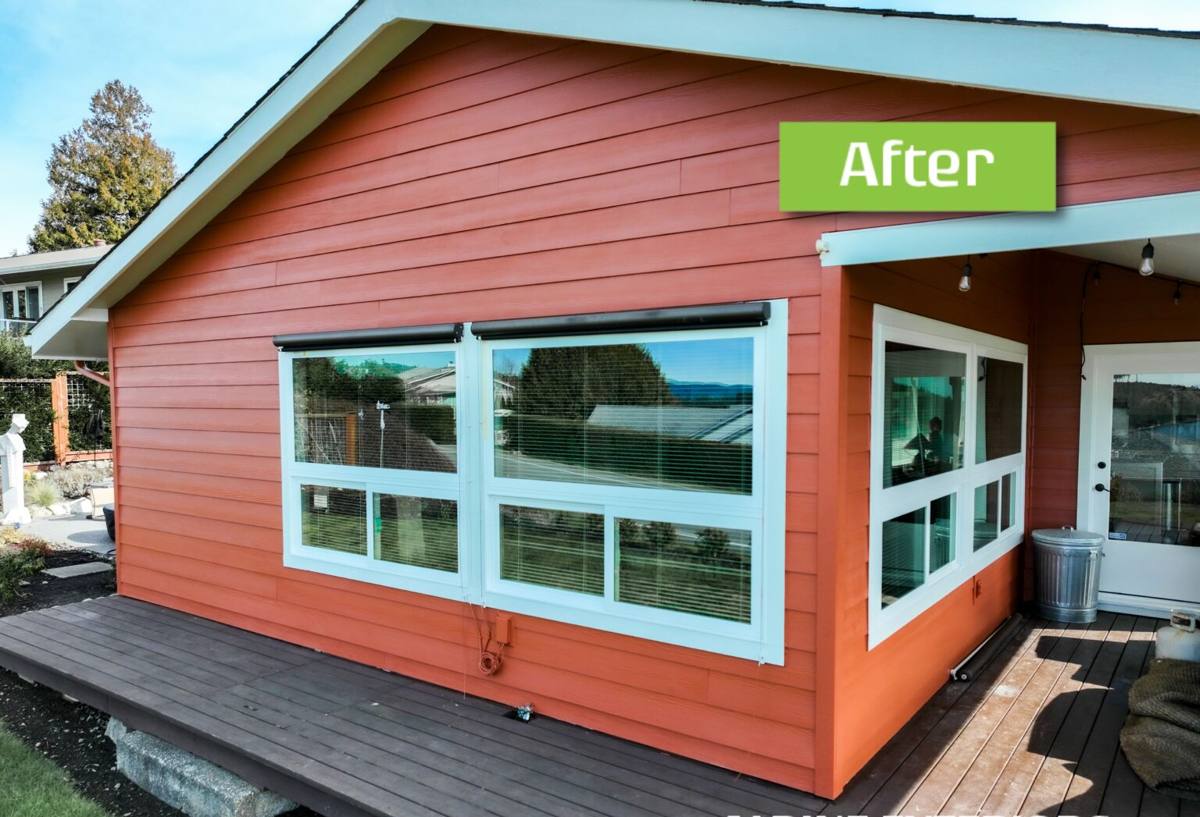
What Whatcom County's Climate Demands from a New Window Install
Sudden Valley and the South Hill area get real rain volume, and it doesn't fall straight down — wind-driven rain off the lake and through the valley pushes water sideways into wall assemblies at pressures a lot of builders underestimate. Add in the region's cooler, damp air for most of the year and you get conditions where any gap in the water-management plan eventually becomes a moisture problem.
Rain and Wind-Driven Moisture
A window opening isn't watertight just because the window itself is rated well. The rough opening, the flashing tape, the sill pan, and the head flashing all have to work together as a system. On new construction we build that system in the correct order — sill pan first, window set and shimmed level and plumb, jamb flashing lapped over the sill pan, then head flashing lapped under the house wrap above the window — so that any water that gets past the exterior cladding drains back out instead of pooling at the sill.
Moss, Algae, and UV on Exterior Trim
The long moss season here isn't just a roof issue. Damp, shaded window trim and sills stay wet longer than in drier climates, which accelerates paint failure on wood trim and can promote algae growth on certain exterior finishes. This is a factor in material selection and in how we detail sills and trim to shed water rather than hold it.
Temperature Swings and Condensation
Whatcom County winters bring cold, damp nights and mild days. Inside a new home with modern insulation and tighter air sealing, that temperature differential can drive condensation on window glass and frames if the glass package and installation aren't matched to the house's overall envelope performance. This is one more reason the window spec has to be decided with the whole build in mind, not chosen off a showroom floor in isolation.
What a Correct New-Construction Window Job Actually Involves
A lot of the work that matters on a new-construction window install happens before the window is ever set in the opening. Framers, siding crews, and window installers all touch the same rough opening at different points in the build schedule, and coordination between those trades is where quality either holds up or falls apart.
Sequencing With Other Trades
We work off the framer's rough openings and confirm they're square, plumb, and sized correctly for the window unit before anything gets installed. Flashing and window setting happen after the weather-resistive barrier is on the wall but before siding starts, so the laps are built in the right order — water always has to be directed down and out over the layer below it, never trapped behind a layer above.
Sill Pan and Flashing Details
A sill pan — whether it's a manufactured pan or field-built with flashing membrane — is non-negotiable on a new build in this climate. It's the backstop that catches any water that finds its way past the window itself and routes it back outside instead of into the framing. We tape and lap every seam in a shingle pattern, working bottom to top, so gravity is always working with the flashing, not against it.
Setting, Shimming, and Fastening
Windows have to be set level, plumb, and square, and shimmed only at manufacturer-specified points so the frame isn't racked or bowed once fasteners are driven. A window that's slightly out of square will operate poorly for the life of the house and can stress the seals around the glass unit prematurely.
Interior and Exterior Sealant
Sealant is the last line of defense, not the first — it should never be relied on as the primary water barrier when the flashing system is doing its job correctly. We use it to close small gaps and provide air sealing, matched to the material it's bonding to.
- Confirm rough opening dimensions, square, and plumb before delivery
- Install or verify weather-resistive barrier is lapped correctly above the opening
- Set sill pan flashing with proper end dams and forward slope
- Set window level, plumb, square, and shim only at manufacturer-specified points
- Flash jambs over the sill pan, then head flashing under the barrier above
- Fasten per manufacturer schedule — not more, not fewer
- Air-seal and insulate the gap between frame and rough opening per code and manufacturer guidance
- Interior and exterior sealant at specified joints only
- Photo-document flashing before it's covered by siding
Product Selection for New Construction in This Climate
New construction gives you a real choice in window frame material and glass package, since you're not constrained by an existing opening or matching old sightlines. For South Hill builds, we steer that conversation around long-term moisture exposure and low-maintenance performance rather than upfront price alone.
| Frame Material | How It Handles This Climate | Maintenance |
|---|---|---|
| Vinyl (quality, welded corners) | Doesn't absorb moisture, no repainting needed, performs well in damp conditions | Low — occasional cleaning |
| Fiberglass | Very stable in temperature swings, strong moisture resistance, holds paint well if a color change is wanted later | Low |
| Wood (clad exterior) | Attractive interior wood look with a protective exterior cladding; exposed raw wood is a poor fit for this rain/moss climate | Moderate — clad side low, interior finish occasional |
| Aluminum | Durable but conducts cold and can condensate more without thermal breaks; less common for residential new builds here | Low, but condensation risk without thermal break |
Glass Packages
For this region, we generally recommend double-pane units with a low-E coating and argon fill as a baseline, with the specific coating and gas-fill spec adjusted based on the home's orientation and how much direct afternoon sun a given elevation gets. South and west-facing glass in a new build often benefits from a different coating than north-facing glass in the same house — it's worth speccing per elevation rather than using one glass package for the whole home.
Our Process for South Hill New-Construction Projects
1. Plan Review and Takeoff
We review the architectural plans or work directly with your builder to confirm window schedule, rough opening sizes, and any custom shapes or sizes before ordering.
2. Site Coordination
We coordinate directly with the general contractor or framer on timing, so windows arrive and get set at the right point in the build sequence — after the weather barrier is up, before siding closes in the opening.
3. Installation
Our crew sets and flashes every window per the checklist above, documenting flashing details with photos before they're covered by siding, so there's a record of the work for the homeowner and the builder.
4. Walkthrough and Sign-Off
Before we leave the site, we walk every window with whoever is managing the build — check operation, check seals, confirm nothing was missed — so it's caught now, not after drywall and siding are done.
Why Hire a Crew That Already Works This Area
A crew that regularly installs windows in Sudden Valley and South Hill has already seen how this specific climate treats a house over a few winters — which details hold up and which ones don't. That's different from general new-construction experience picked up in a drier or milder region. We know how much wind-driven rain a west-facing wall near the lake can take in a January storm, and we build the flashing system with that in mind rather than to a generic minimum-code standard.
We also know the practical side of building here — the local building department's inspection expectations, the pace new-construction sites in Whatcom County run on, and how to keep a window installation from becoming the bottleneck that holds up siding and interior trim crews.
Cost Factors on a New-Construction Window Package
Pricing on a new build depends less on "windows versus no windows" and more on the choices baked into the plans. The factors below are what actually move the number.
| Factor | Why It Matters |
|---|---|
| Number and size of window openings | Larger and more numerous openings mean more material and labor |
| Frame material chosen | Vinyl, fiberglass, and clad-wood carry different unit costs |
| Custom or specialty shapes | Arched, oversized, or corner windows require special ordering and installation time |
| Glass package upgrades | Higher-performance low-E coatings or triple-pane units add cost per unit |
| Site access and scheduling | Coordinating tightly with other trades on an active build site affects labor efficiency |
Broadly, expect new-construction window packages for a typical single-family home to run from the low tens of thousands into higher figures depending on window count, size, and material — we'll give you a real number once we've seen the plans, not a guess pulled from a different job.
Ready to Talk About Your South Hill Build?
If you're planning a new build in South Hill or elsewhere around Sudden Valley, we're glad to review your plans and walk through window options before you're locked into a spec. Reach out for a free, no-pressure estimate using the form below.