 Sudden Valley Window
 Sehome's Climate Is Rougher on Siding Than It Looks
Sehome sits in Whatcom County's marine climate belt, close enough to Bellingham Bay to catch salt-laden air off the water and close enough to the hills to sit under tree cover for a good part of the year. That combination is harder on exterior siding than most homeowners realize. Salt air accelerates corrosion on fasteners and trim metal. Driving rain, often pushed sideways by wind off the water, finds its way into any gap in the water-resistive barrier or flashing. And the region's long, mild, damp winters give moss and algae months at a time to colonize north-facing walls, shaded eaves, and anything under a tree canopy.
None of that is unique to one street or one lot — it's the baseline condition for exterior work anywhere in this part of Whatcom County. But it means siding material and installation detail matter more here than they would in a drier, sunnier climate. A product or installation method that would hold up fine in eastern Washington can fail early in Sehome simply because it was never designed for sustained moisture exposure and salt air.
What James Hardie's HZ5 Product Line Is Engineered For
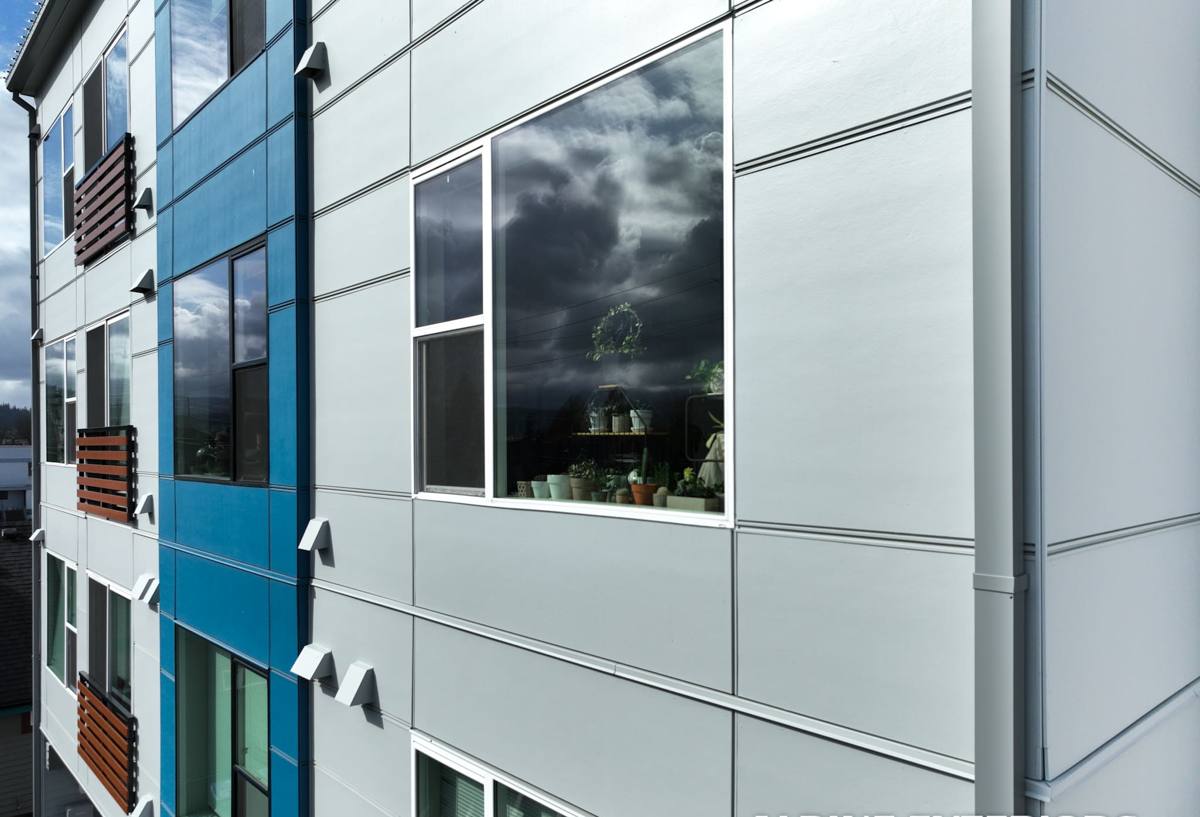
James Hardie builds region-specific formulations of its fiber cement siding, and the Pacific Northwest — including Whatcom County — falls under the HZ5 engineered line. HZ5 is formulated for colder, wetter climates: it's built to resist moisture intrusion, freeze-thaw cycling, and the kind of sustained dampness that Sehome sees for much of the year. That's different from the HZ10 line built for hot, dry, high-UV southern climates. Installing the wrong regional formulation, or installing HZ5 without following Hardie's climate-specific fastening and clearance specs, is one of the more common ways a fiber cement job underperforms.
Beyond the formulation, three things make James Hardie the product we put on Sehome homes:
- Non-combustible core — fiber cement doesn't feed a fire the way wood-based products can, which matters in a region with periodic wildfire smoke and ember exposure.
- ColorPlus factory finish — a baked-on finish that resists the fading and peeling that field-applied paint struggles with under constant damp-dry cycling.
- Dimensional stability — fiber cement doesn't swell, cup, or split the way wood and some composite sidings do when they take on repeated moisture.
Why We Only Install James Hardie
We don't install vinyl, LP SmartSide, Cemplank, Allura, or raw cedar, and that's a deliberate standard, not a lack of options. Vinyl expands and contracts significantly with temperature swings and can warp; it also isn't a great match for a climate where UV exposure is lower but moisture exposure is constant. LP SmartSide and other wood-strand products perform well when detailing is perfect, but their engineered-wood core is more sensitive to sustained moisture than fiber cement, and this climate doesn't give a product much room for installation error. Cedar looks great new but demands a maintenance schedule — refinishing, moss treatment, caulk renewal — that most homeowners underestimate until they're several years in. James Hardie gives us a non-combustible, dimensionally stable product with a factory finish and a strong transferable warranty, which is a better match for what this climate actually does to a house over 20-plus years.
Signs Your Current Siding Is Losing the Fight
If your siding is original to the house or hasn't been touched in a decade or more, a few warning signs tell you the clock is running out — some are cosmetic, some point to moisture already behind the cladding.
- Persistent green or black staining that comes back within weeks of a wash, especially on north- or shade-facing walls
- Soft, spongy, or crumbling spots when you press on the siding, particularly near the bottom courses and around window trim
- Paint that's peeling, bubbling, or alligatoring rather than just fading
- Visible gaps, cupping, or warping at panel seams and butt joints
- Caulk that's cracked, shrunk, or pulled away from trim and window flashing
- Insect activity — carpenter ants or similar — concentrated around lower wall sections or roof-siding intersections
Any one of these on its own might just mean a maintenance visit. Several together, especially soft spots plus staining, usually means moisture has been getting behind the siding for a while and it's worth a full inspection before deciding on repair versus replacement.
What a Correct Installation Actually Involves
Flashing and Water Management Come First
The siding itself is the least important part of keeping water out of a wall — the water-resistive barrier, window and door flashing, and kick-out flashing at roof-wall intersections are what actually stop bulk water. In a climate with as much driving rain as this one, we treat this layer as non-negotiable: house wrap installed shingle-style so every seam sheds water downward, proper flashing tape at every penetration, and kick-out flashing anywhere a roofline meets a wall, so runoff doesn't dump straight down behind the siding.
Clearances and Fastening
James Hardie specifies minimum clearances from grade, roof lines, and decks — typically several inches — specifically so the bottom edge of the siding isn't sitting in standing water or snow. Skipping those clearances to save a course of siding is one of the most common shortcuts that shows up as rot five to ten years later. Fastener placement and type matter too: Hardie's specs call for corrosion-resistant fasteners driven at the correct location on the plank, not just "close enough," because misplaced fasteners can cause cracking or reduce wind and water resistance.
Field Joints and Caulking
Every butt joint, corner, and trim intersection is a place water can get in if it's caulked wrong or not backed properly. We follow Hardie's joint treatment specs — including which joints should be caulked and which are designed to be left as tight butt joints without caulk — because over-caulking can trap moisture just as easily as under-caulking lets it in.
Comparing Siding Options for a Sehome Home
| Factor | James Hardie Fiber Cement | Vinyl | Cedar | LP SmartSide |
|---|---|---|---|---|
| Moisture tolerance in a marine climate | High — engineered HZ5 formulation for this region | Moderate — doesn't rot, but can warp with heat/cold cycling | Low without diligent upkeep | Moderate — sensitive to sustained moisture at cut edges/joints |
| Moss/algae resistance | Good with factory finish; washes clean | Fair; can stain over time | Poor; needs regular treatment | Fair |
| Fire performance | Non-combustible core | Combustible | Combustible | Combustible |
| Typical maintenance | Occasional wash, caulk checks | Low, but repairs can be hard to color-match | Refinishing every few years | Regular paint/caulk upkeep |
| Relative install cost tier | $$–$$$ | $ | $$$ | $$ |
Cost tiers vary a lot by home size, tear-off scope, and trim detail, so treat that row as directional, not a quote — the only way to get a real number is an on-site look at your specific home.
Our Process, Start to Finish
- On-site inspection — we look at your current siding, trim, flashing condition, and any moisture damage before recommending anything.
- Scope and estimate — a written plan covering tear-off, any sheathing repair, water-resistive barrier, trim, and the specific Hardie product and ColorPlus color.
- Tear-off and sheathing check — old siding comes off and we inspect the sheathing underneath for hidden rot before anything new goes up.
- Water-resistive barrier and flashing — house wrap and flashing installed or repaired to current best practice, not just patched around.
- Hardie installation — installed to manufacturer clearance, fastening, and joint specs, not shortcuts.
- Trim, caulk, and touch-up — factory-matched touch-up paint at cut edges, correct joint treatment throughout.
- Final walkthrough — we go over the finished work with you before calling the job done.
Why a Crew That Already Works Sehome Matters
Siding crews that mostly work drier inland climates sometimes bring habits that don't hold up here — skipping kick-out flashing because it "usually doesn't matter," or scheduling around weather in a way that leaves a wall open to rain overnight. A crew that regularly works Whatcom County's wetter, shadier lots plans differently: tighter tarping and sequencing during tear-off, more attention to the flashing details that matter most in sustained rain, and familiarity with how moss and algae actually behave on local homes so the finish choice and maintenance advice are realistic rather than generic. That local pattern recognition doesn't show up on a spec sheet, but it's a real part of what separates a siding job that looks good for two years from one that performs for twenty.
Maintenance and Warranty in a Marine Climate
James Hardie's ColorPlus finish carries a separate, strong finish warranty on top of the product warranty, and both are transferable if you sell the home — a genuine selling point in a market where buyers ask about exterior condition. In practice, keeping a Hardie exterior looking right in this climate is low-effort compared to wood or vinyl: an occasional gentle wash to keep moss and algae from taking hold on shaded walls, a yearly look at caulk lines and trim joints, and prompt attention if you ever notice a soft spot or persistent stain. None of that is heavy maintenance — it's the kind of once- or twice-a-year check that catches a small issue before it becomes a wall repair.
If your current siding is showing staining, soft spots, or failing paint, or you're planning ahead for a home in Sehome, we're happy to walk the exterior with you and give you a straight assessment — no pressure, no upsell, just what we'd actually recommend for your home. Request a free estimate below and we'll set up a time to take a look.