 Sudden Valley Window
 Why Silver Beach's Climate Is Hard on Siding
Homes in the Silver Beach area near Sudden Valley sit right in the path of everything western Whatcom County weather can throw at a house. Moisture-laden marine air moves through the trees and off the water most of the year, rain arrives sideways more often than straight down, and the tree cover that makes this part of the county beautiful also means shade, damp bark, and slow-drying siding for months at a stretch. Add a moss season that can run from early fall through late spring, and you have conditions that punish any siding product with a weak spot.
Moisture from every direction
Driving rain doesn't just hit a wall face-on — it gets pushed up under laps, into corner joints, and behind trim by wind. Siding that isn't installed with the right clearances and flashing details will eventually take on water at those points, even if the material itself is rated for wet climates. The failures we see most often in this area aren't in the middle of a wall panel; they're at butt joints, around window and door trim, and at the bottom edge near grade where splashback and standing moisture do their damage over years, not days.
Moss, algae, and constant shade
Tree-shaded lots around Silver Beach and Sudden Valley hold moisture longer than open, sunny lots elsewhere in the county. That means more time for moss and algae to take hold on north-facing walls and anything close to overhanging trees. Some siding materials feed that growth or trap moisture against their surface; others shed water and dry out fast enough that organic growth has a harder time getting established. That difference matters more here than it would on a drier, more open lot.
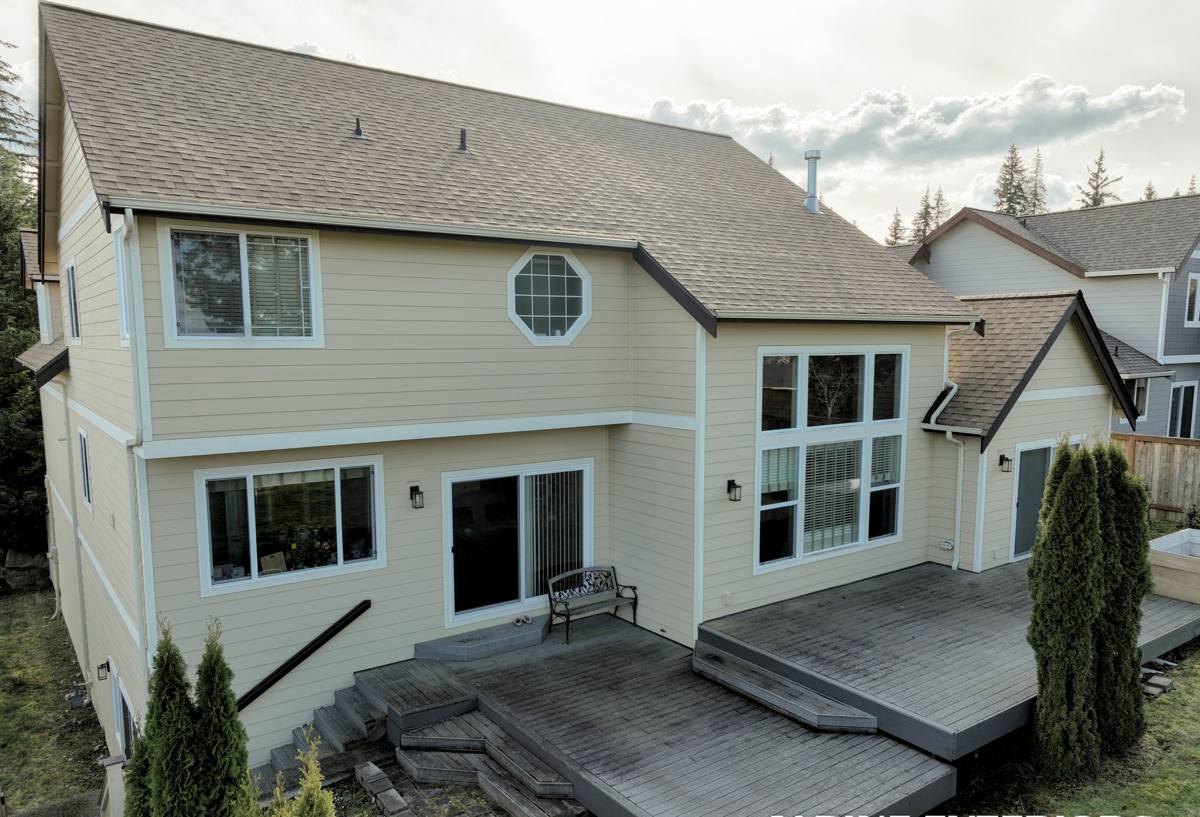
What Fiber Cement Siding Needs to Do on a Home Like Yours
Not every fiber cement product performs the same way in this climate, and not every installer treats moisture management the same way either. For a Silver Beach home, siding needs to do three things well: shed wind-driven rain without trapping it against the sheathing, resist swelling and softening at cut edges and joints where moisture likes to sit, and hold a factory finish long enough that you're not repainting every five to seven years in a climate that's hard on paint. That's the bar we hold every installation to, and it's the reason we don't treat siding installation as a one-size-fits-all trade.
Why We Install Only James Hardie Fiber Cement
We made a decision early on to install James Hardie products exclusively — not LP SmartSide, not vinyl, not other fiber cement brands, not primed wood. That's a narrower lineup than a lot of contractors offer, and we're upfront about why. Hardie's fiber cement is non-combustible, doesn't rely on organic wood fiber that can absorb moisture and swell the way engineered wood siding can, and comes with a factory-applied ColorPlus finish backed by its own warranty — so the color coat isn't something our crew is responsible for touching up in year two.
Hardie also builds its siding in engineered "HZ" formulations matched to climate zones, which is directly relevant here: a product engineered for a wet, moderate Pacific Northwest climate behaves differently over twenty years than one engineered for a dry southern climate. Standardizing on one manufacturer also means our crews aren't relearning fastening patterns, clearances, and finish requirements for a different product every other job — the installation quality stays consistent because the specs don't change.
- Non-combustible fiber cement core — doesn't feed a fire the way wood-based siding products can
- Factory-applied ColorPlus finish with its own product warranty, not a field-applied coat
- Engineered HZ product line matched to Pacific Northwest moisture and temperature patterns
- Transferable limited warranty that stays with the house if you sell
- Consistent installation specs our crew follows on every job, not a different manual per product
What a Correct Installation Actually Involves
Fiber cement siding is only as good as the details underneath it. This is where most of the difference between a job that lasts decades and one that fails early actually shows up — and it's mostly invisible once the siding is up.
Weather-resistive barrier and flashing
Every wall gets a continuous weather-resistive barrier before any siding goes on, with proper lapping and taping at seams so water that gets past the siding has a drainage path instead of a place to pool. Window and door openings get flashed so water sheds outward and down, not sideways into the wall cavity. This step matters more in a driving-rain climate than it does somewhere drier, and it's the step that's easiest to rush.
Clearances and fastening
Hardie's specifications call for specific clearances from grade, roofing, decks, and other horizontal surfaces so the bottom edge of the siding isn't sitting in standing water or constant splashback — a real risk on wooded, uneven Silver Beach lots. Fasteners go in at the correct spacing and depth; overdriven or underdriven nails are one of the most common causes of early siding problems, and it's a detail that's easy to get wrong at production speed.
Joints, caulking, and finish integrity
Butt joints get treated correctly rather than just butted and caulked over — caulk is a backup, not the primary water management strategy. We also keep the factory ColorPlus finish intact through handling and installation, since field-touching cut edges and joints correctly is part of what keeps that finish warranty valid.
Our Process for Silver Beach Projects
- On-site assessment: We walk the exterior, check current siding and trim condition, note tree cover, drainage patterns, and any moisture or moss problem areas specific to the lot.
- Product and profile selection: We recommend a Hardie lap, shingle, or panel profile and color based on the home's style and exposure, not a default option.
- Written estimate: A clear scope covering removal, any sheathing repair, weather barrier, siding, trim, and cleanup — no vague allowances.
- Prep and tear-off: Old siding comes off, sheathing gets inspected for rot or water damage before anything new goes on top of it.
- Weather barrier and flashing installation: The part of the job that determines how the siding performs in ten years, done before a single piece of Hardie board goes up.
- Siding installation to spec: Correct clearances, fastening, and joint treatment throughout.
- Final walk-through: We review the finished job with you before calling it done.
Fiber Cement Siding Profiles and Cost Factors
Hardie offers several siding profiles, and the right one depends on the home's style, its exposure to weather, and budget. Cost on any given Silver Beach project depends less on the siding brand and more on the variables below.
| Factor | Why It Affects Cost |
|---|---|
| Siding profile (lap, shingle, panel) | Shingle profiles take more labor time per square foot than lap siding |
| Sheathing condition | Rot or water damage found during tear-off adds repair scope before new siding goes on |
| Home height and access | Multi-story sections, steep lots, and limited equipment access increase labor time |
| Trim and detail work | Corner boards, window trim, and fascia detail add material and labor |
| Color and finish | Factory ColorPlus finish costs more upfront but eliminates a repaint cycle |
| Tree removal or trimming needed | Wooded lots sometimes need branch clearance for proper drying and installation access |
We give a written, itemized estimate before any work starts so you know exactly what's driving the number, not a single lump figure.
Signs Your Current Siding Is Already Failing
In this climate, siding problems don't announce themselves right away. A few things worth checking before they turn into sheathing or framing repairs:
- Soft or spongy spots when you press on the siding, especially near the bottom courses
- Persistent moss or dark staining that comes back within weeks of cleaning
- Visible gaps, warping, or buckling at joints and corners
- Peeling or bubbling paint that keeps returning after repainting
- Increased drafts or a musty smell near exterior walls
- Siding that feels cool and damp to the touch well after rain has stopped elsewhere on the property
Why Hiring a Crew That Already Works This Neighborhood Matters
A crew that's worked homes around Sudden Valley and Silver Beach already knows what this specific stretch of Whatcom County does to an exterior — the tree cover, the moisture patterns, the moss regrowth cycle, the wind-driven rain off the water. That's not something you can fully account for from a general regional install manual. It shows up in small decisions: where to add extra flashing attention, which wall faces need the most clearance from grade, and how to sequence a job around a wet season that's longer here than it is in a lot of the rest of the state. Local experience doesn't replace following manufacturer specs — it means knowing which specs matter most on a given lot.
Caring for Hardie Siding After Installation
Correctly installed Hardie siding is low-maintenance, not zero-maintenance. An annual rinse to keep moss and organic buildup from taking hold, especially on shaded north-facing walls, keeps the factory finish looking right and prevents the kind of surface staining that's harder to remove the longer it sits. Keep an eye on caulking at joints and trim over the years and have it touched up if it starts to crack or pull away — that's a five-minute check that prevents a much bigger repair down the line. Beyond that, correctly installed Hardie siding is built to go a long time without asking much of you.
If you're dealing with aging, failing, or moss-covered siding on a Silver Beach home, we're happy to take a look and give you a straight, no-pressure estimate on what correct James Hardie siding would look like on your house — no obligation, just an honest assessment.