 Sudden Valley Window
 Composite Decking Built for This Side of Whatcom County
Sunnyland sits close enough to the water that salt-laden air reaches the wood on your deck year-round, and Sudden Valley's tree cover and lake-effect dampness keep everything shaded and wet for months at a stretch. Between the two, this is a tough neighborhood for outdoor wood. A deck here isn't just furniture for the yard — it's a structure that has to shed water fast, resist moss and mildew, and hold up under repeated wet-dry cycles that loosen fasteners and swell boards. Composite decking, installed correctly for this specific climate, handles that better than most alternatives. This page is about what "installed correctly" actually means here, not a generic pitch for the product.
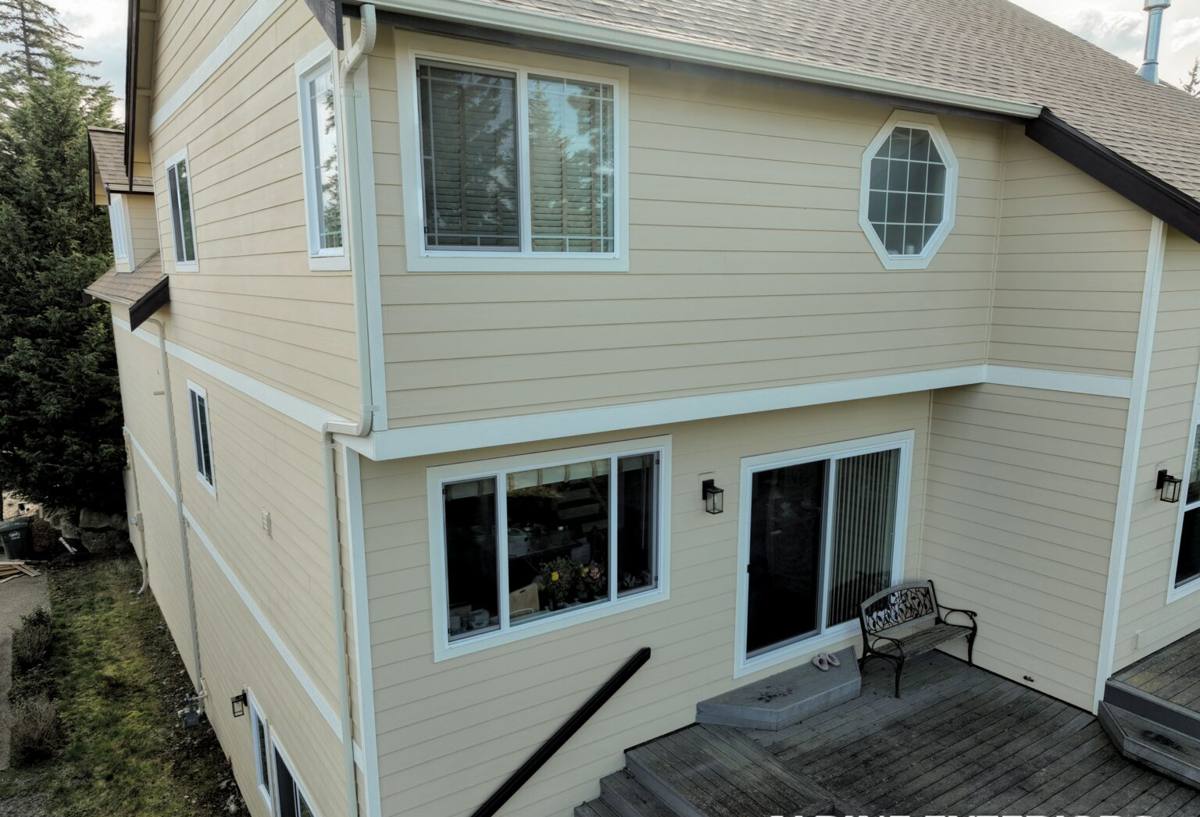
What Whatcom County Weather Does to a Deck
Three things drive most of the deck problems we see in this area:
- Driving rain: wind-blown rain gets under railings and into end-grain cuts, ledger connections, and fastener holes — the places builders often treat as an afterthought.
- Long moss season: shaded, damp decks here can stay wet for weeks in the fall and winter, which is exactly the condition moss and algae need to take hold on any surface with texture or grain.
- Salt air: even set back from the water, this area gets enough marine air movement to accelerate corrosion on cheap fasteners, hidden clips, and railing hardware over a decade of exposure.
None of these are dramatic on their own. What they do is compound. A deck that's fine in year one starts showing soft spots, dark staining, and loose boards by year five or six if it wasn't built with this climate in mind — regardless of what decking material sits on top.
Why Composite Makes Sense Here — With a Caveat
Modern capped composite decking doesn't absorb water the way wood does, doesn't need annual sealing, and won't rot from the inside the way an untreated or poorly-treated wood board eventually will. That's a real advantage in a climate that keeps decks wet for a large part of the year. But composite isn't maintenance-free, and it isn't immune to moss — it's just easier to keep clean than wood, and it won't structurally fail from the surface staying damp. The caveat: composite decking is only as good as the frame underneath it and the way it was installed. We've replaced composite deck surfaces that looked fine on top but were failing at the framing level because the substructure wasn't built for this much moisture.
Capped vs. Uncapped Composite
We install capped composite (a protective polymer shell wrapped around the board) rather than older uncapped composite formulations. Uncapped composite is more porous, so it holds moisture and grows moss and mildew faster in a climate like this — sanding and cleaning only gets you so far before the surface starts wearing unevenly. Capped composite sheds water and resists staining far better, which matters more here than in a drier inland climate where the maintenance difference is less noticeable.
The Substructure Nobody Sees — and Where Failures Actually Start
Most deck problems we get called out for in this area aren't decking problems, they're framing problems. The board on top is the last thing that fails, not the first.
- Ledger flashing: where the deck attaches to the house needs proper flashing and a water-resistant barrier behind it — this is the single most common source of hidden rot we find on older decks.
- Joist protection: joist tape or a comparable moisture barrier over the top of each joist keeps rainwater from wicking into the wood framing through fastener holes.
- Fastener grade: in a salt-air environment, stainless or high-grade coated fasteners matter more than they would further inland — cheap fasteners corrode and stain the decking around them within a few years.
- Drainage and airflow under the deck: low, shaded decks that don't get airflow underneath stay damp longer, which speeds up both moss growth on top and framing decay below.
Composite decking installed over a frame that skips these details will still look good for a while, but the structure underneath won't hold up the way it should for a 25+ year decking product.
How We Approach a Sunnyland Composite Deck Project
1. Site Evaluation
We look at sun exposure, shade cover, slope, and how close the deck sits to grade — all of which affect how much moisture and moss pressure that specific spot will see over the year. A shaded, north-facing deck near tree cover gets a different drainage and spacing approach than an open, south-facing one.
2. Demo and Framing Assessment
If we're replacing an existing deck, we check the ledger connection and joists before anything else. This is where we find out whether the frame is sound enough to build on, or whether framing repair needs to be part of the scope before decking goes down.
3. Framing Correction
Ledger flashing, joist tape, proper joist spacing for the specific composite board being used (composite often needs tighter joist spacing than wood, especially on angled or diagonal layouts), and corrosion-resistant fasteners throughout.
4. Decking Installation
Hidden fastener systems where the board allows it, correct board gapping for expansion and drainage, and picture-frame or border detailing where it fits the design. Cut ends get capped or sealed per manufacturer spec so exposed core material isn't left to absorb water.
5. Railing and Finish Work
Railing posts get the same attention to flashing and fastener grade as the deck frame — a railing post that rots at the base is a safety issue, not just a cosmetic one.
Composite vs. Wood vs. PVC: How They Hold Up in This Climate
| Factor | Pressure-Treated Wood | Capped Composite | PVC (Cellular) |
|---|---|---|---|
| Moisture behavior | Absorbs water; swells, cups, checks over time | Water-resistant shell; minimal absorption | Fully water-resistant; won't absorb |
| Moss/mildew resistance | Low — porous surface holds moisture | Good — smooth cap sheds water and debris | Very good — non-porous surface |
| Maintenance | Annual sealing/staining, regular cleaning | Periodic washing, no sealing needed | Periodic washing, no sealing needed |
| Upfront cost | Lowest | Mid-range | Highest |
| Typical lifespan (this climate) | 10–15 years before major repair | 25–30 years with proper framing | 25–30+ years with proper framing |
We install all three depending on budget and goals, but for most Sunnyland and Sudden Valley homeowners replacing an aging wood deck, capped composite is the point where cost and long-term performance line up best for this climate.
Maintenance Composite Still Needs Here
"Low-maintenance" doesn't mean "no maintenance," especially with this much moss pressure. A composite deck in this climate still needs:
- A rinse or soft wash 2–4 times a year, more often on shaded sections, to keep moss and organic buildup from taking hold
- Prompt clearing of leaves and debris from between boards and in corners, where trapped moisture sits longest
- Keeping planters, mats, and furniture feet from staying in one spot too long — trapped moisture under an object is the most common cause of localized staining on composite
- An annual check of railing posts and fastener points for movement, which is often the first sign of a framing issue rather than a decking issue
None of this is heavy work, but skipping it entirely for years at a time in a climate like this will still leave a deck looking worse than it should.
Cost Factors for a Sunnyland Deck Project
Every project is different, but the main things that move the price on a composite deck job in this area are:
| Factor | Why It Matters |
|---|---|
| Existing frame condition | A sound frame keeps costs down; rotted joists or a bad ledger connection add repair scope |
| Deck size and shape | Complex layouts, curves, and multiple levels add labor and material waste |
| Board grade | Capped composite lines vary in price based on color depth, streaking, and warranty length |
| Railing system | Composite, aluminum, and cable railing all price differently and affect install time |
| Height and stairs | Elevated decks and multi-run stairs add framing, footings, and code requirements |
| Permit requirements | Decks attached to the house or built above a certain height typically require a Whatcom County permit, which adds time and a modest fee |
Why Hiring a Crew That Already Works This Neighborhood Matters
A deck built to a generic spec sheet and a deck built for Sunnyland's actual weather aren't the same job, even if they use the same composite board. A crew that already works Sudden Valley and the surrounding Whatcom County neighborhoods knows which spots hold shade and moisture longest, how local permit review handles attached decks, and which framing details are worth the extra time given how wet this climate stays for most of the year. That's the difference between a deck that looks right on installation day and one that's still solid in fifteen years.
If you're weighing a new composite deck or replacing an aging wood one in Sunnyland or Sudden Valley, we're happy to take a look and give you a straightforward, no-pressure estimate — what your specific site needs, what it'll cost, and why. Use the form below to get started.