 Sudden Valley Window
 Decking That Has to Hold Up to Barkley's Weather, Not Just Look Good on Day One
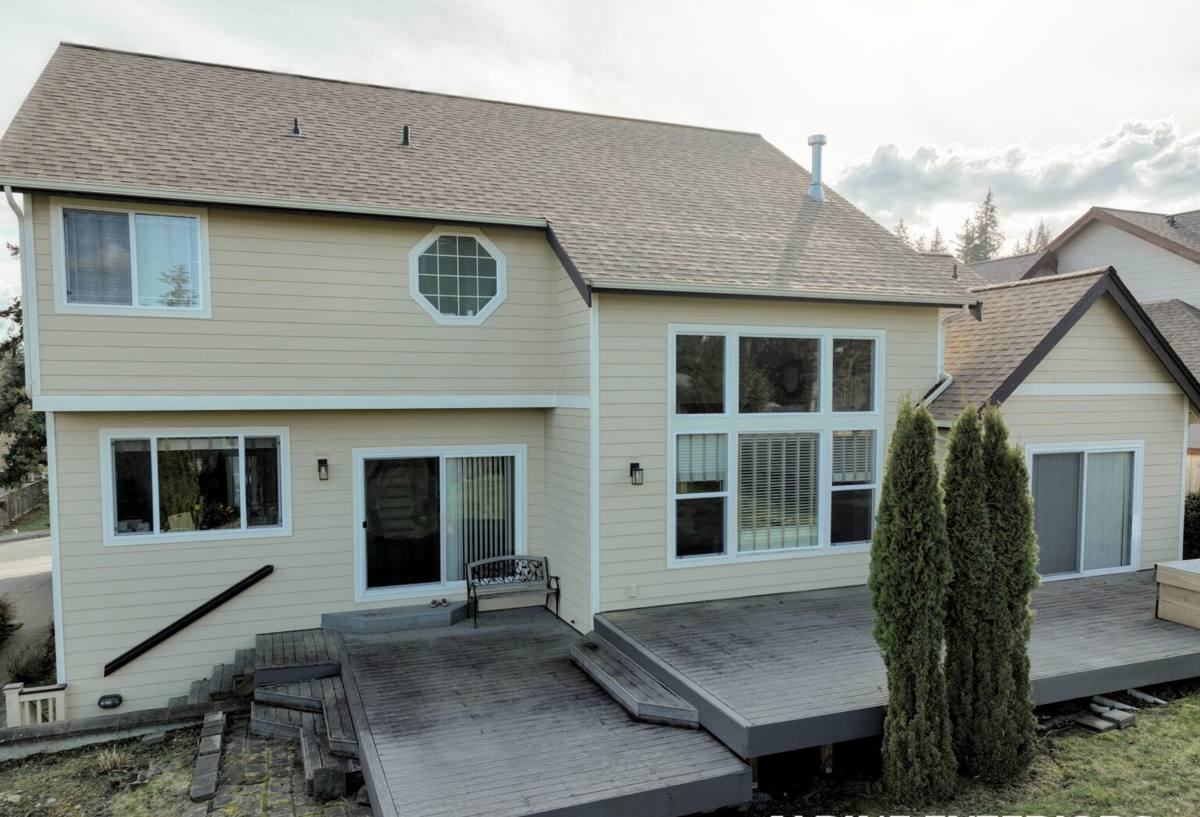
Barkley homes sit in a part of Whatcom County where the weather doesn't do anything halfway. Winters bring long stretches of driving rain that never seems to fully dry between storms. The marine-influenced air carries moisture and salt that settle into anything porous. And from late fall through early spring, north-facing decks and anything shaded by trees or the house itself grow moss almost on schedule. A deck built without those three things in mind — rain, salt-laden air, and moss — will look tired within a few years no matter what it's made of.
Composite decking exists specifically to handle that kind of punishment better than wood does, but only when it's specified and installed correctly for the site. A lot of the composite decking problems we get called out to look at in and around Sudden Valley aren't material failures — they're installation shortcuts that let moisture sit where it shouldn't, or board choices that weren't matched to how much shade and rain a particular deck actually gets.
What Barkley's Climate Actually Does to a Deck
Driving Rain and Standing Moisture
Rain in this part of Whatcom County rarely falls straight down. Wind-driven rain gets pushed under railings, into board gaps, and against house walls where decks attach. If the substructure and flashing aren't detailed for that, water works its way into framing and stays there, hidden under the deck surface where you won't see a problem until it's already serious.
Moss and Algae Growth
Composite decking doesn't rot the way wood does, but the surface texture of some boards still gives moss and algae spores somewhere to grab hold, especially on decks with limited sun exposure or heavy tree cover — common around Barkley's more wooded lots. Once moss establishes itself in board grooves or along fastener lines, it holds moisture against the board even longer, which compounds the problem.
Salt-Influenced Air and Metal Hardware
Whatcom County's proximity to marine air means fasteners, brackets, and railing hardware corrode faster here than they would further inland. A deck that looks solid can still have hardware quietly failing underneath if the wrong grade of fastener was used.
What a Correctly Installed Composite Deck Involves
Composite boards are only as good as what's underneath them. A correct installation for a Barkley home addresses several things that don't show up in a showroom sample:
- Pressure-treated or naturally durable framing lumber, spaced and spanned to the manufacturer's specification — not stretched to save on joists
- Joist tape or a comparable moisture barrier on top of every joist, so the framing underneath isn't taking on water through the fastener holes
- Proper ledger board flashing where the deck attaches to the house, since this is one of the most common points where water gets behind siding and into wall framing
- Hidden fastener systems or manufacturer-approved screws rated for coastal or marine environments, not standard hardware store deck screws
- Consistent gapping between boards for drainage and seasonal expansion — composite still moves with temperature, even if it doesn't warp like wood
- Ventilation underneath the deck so airflow can help dry out anything that does get wet
None of this is visible once the deck is finished, which is exactly why it matters. A deck that looks identical from the top can perform completely differently ten years out depending on what was done underneath.
Choosing a Composite Board for This Environment
Not all composite decking is built the same way, and the differences matter more in a climate like this than they would in a drier region. Fully capped composite boards — where a protective polymer shell wraps the board on all sides — handle moisture and moss exposure noticeably better than older, uncapped composite formulations that only protect the top surface.
| Decking Type | Moisture Behavior | Moss/Algae Resistance | Maintenance Burden |
|---|---|---|---|
| Natural wood (cedar, fir) | Absorbs water, prone to swelling and rot if not sealed regularly | Low resistance without treatment | High — annual sealing/staining |
| Uncapped composite | Better than wood, but core can absorb moisture at cut ends and edges | Moderate — surface can hold organic growth | Moderate — periodic cleaning |
| Fully capped composite | Shell resists moisture absorption on all faces | Higher resistance, easier to clean off | Low — routine washing |
| PVC/cellular decking | No wood content, minimal moisture absorption | High resistance | Low, but can show scratches more |
We generally steer Barkley homeowners toward fully capped composite for anything shaded, low-lying, or under trees, and reserve less-protected board options for full-sun, well-ventilated decks where moisture exposure is lower to begin with. This isn't a knock on any particular manufacturer — brands like Trex, TimberTech, and Fiberon all make capped and lower-tier lines, and the right pick depends on the specific deck's exposure, not brand loyalty.
Substructure and Drainage: The Part Nobody Sees
If there's one place we see corners cut on older or budget composite deck installs, it's the substructure. A deck can have premium boards on top and still fail early if the framing underneath was never properly protected. In a climate that stays wet for months at a stretch, a few details make an outsized difference:
Joist Protection
Uncovered joist tops absorb water at every fastener hole. Joist tape closes that off and is inexpensive relative to the protection it buys.
Ledger Flashing
Where the deck ties into the house, flashing has to shed water away from the wall assembly, not toward it. This is one of the highest-consequence details on the whole project because a failure here affects the house, not just the deck.
Grading and Drainage Below the Deck
On sloped Barkley lots, water needs somewhere to go once it passes through the deck boards. Poor grading underneath a low deck traps moisture against framing and encourages moss and mildew to creep up from below, not just settle on top.
Railings, Fascia, and Trim
Composite fascia boards and matching trim give a deck a finished look and hide the structural edge, but they also need to be installed with the same moisture logic as the decking itself — back-ventilated where possible, with fasteners rated for the same conditions. For railings, aluminum and composite systems both hold up well against Whatcom County's damp air; wood railings require the same ongoing maintenance as any exposed wood component and tend to show weathering faster than the deck surface itself.
Our Process, Start to Finish
- On-site assessment — we look at sun exposure, tree cover, existing framing condition (if replacing a deck), and how the site drains, since all of that affects board and substructure recommendations.
- Board and layout recommendation — matched to the deck's actual exposure, not a one-size-fits-all pitch.
- Substructure work — framing repair or replacement, joist protection, and ledger flashing done before a single composite board goes down.
- Installation — hidden fastening where the board system allows it, consistent gapping, and proper edge and stair detailing.
- Walkthrough — we go over basic care and answer questions before we consider the job finished.
Maintenance in a Moss-Prone, Marine Climate
Composite decking is genuinely lower-maintenance than wood, but "low-maintenance" doesn't mean "no maintenance" in this climate. A simple seasonal routine keeps a Barkley deck looking and performing the way it should:
- Sweep off leaves and debris regularly through fall — trapped organic matter is what feeds moss growth
- Wash the deck surface with a soft-bristle brush and a composite-safe cleaner once or twice a year, more often on shaded sections
- Avoid pressure washers on high settings directly against board grooves, which can force water into fastener areas
- Check railing hardware annually for early corrosion, especially on decks with any marine air exposure
- Keep gutters and downspouts near the deck clear so runoff isn't dumping extra water onto or under the deck surface
- Trim back overhanging branches where practical to reduce shade and moss-friendly conditions
Why It Matters That We Already Work in Barkley
Deck problems in this area tend to repeat themselves for the same reasons: substructure details that weren't built for sustained rain, board choices that didn't account for shade and moss exposure, and hardware that wasn't rated for the air quality here. A crew that already works throughout Sudden Valley and the surrounding Whatcom County neighborhoods has already seen how these decks perform five and ten years out, not just on installation day. That matters for board selection, for framing decisions, and for knowing which details are worth spending a little more on up front versus which are optional.
Local permitting requirements and inspection expectations also vary by jurisdiction, and a crew familiar with the area's process can keep a project moving without avoidable delays.
Cost Factors to Expect
Composite decking costs vary widely based on board tier, deck size, substructure condition, and railing choice. As a general guide, most composite deck projects fall in a broad range from budget-conscious capped composite with simple railings up to premium board lines with aluminum or glass railing systems. The table below outlines what tends to move the price up or down, without pretending every project fits a fixed number.
| Factor | Lower Cost | Higher Cost |
|---|---|---|
| Board tier | Entry-level capped composite | Premium capped or PVC decking |
| Substructure condition | Existing framing reusable | Full framing replacement needed |
| Railing system | Basic composite or wood railing | Aluminum, cable, or glass railing |
| Deck size and shape | Simple rectangular footprint | Multi-level or curved layouts |
| Site access | Easy material access | Difficult access, sloped lot, hand-carry required |
The only way to get an accurate number for a specific Barkley property is to look at the site itself — existing structure, exposure, and what the homeowner actually wants out of the space all factor in.
If you're planning a new composite deck or replacing an aging one in Barkley, we're glad to come take a look and give you a straightforward, no-pressure estimate based on your home's actual conditions — no generic quote pulled out of thin air.