 Sudden Valley Window
 Why Bellingham Homes Need a Different Approach to Siding
Bellingham sits close enough to the water and far enough into the Pacific storm track that its homes take a specific kind of beating: salt-tinged marine air, long stretches of driving rain off the Strait, and a moss season that can run eight months out of the year in shaded, north-facing spots. None of that is dramatic on any given day. It's the accumulation that wears siding down — moisture that never fully dries between storms, organic growth that holds water against the wall, and salt exposure that slowly degrades finishes and fasteners that weren't specified for it.
Whatcom County's climate isn't hostile in the way a hurricane zone is hostile. It's patient. Siding that's marginal on day one — a weak paint film, a wood substrate, a cladding that swells when it takes on moisture — doesn't fail dramatically here. It fails slowly, over years, in ways that are easy to miss until there's soft trim, peeling paint, or a moss mat holding water against the wall sheathing.
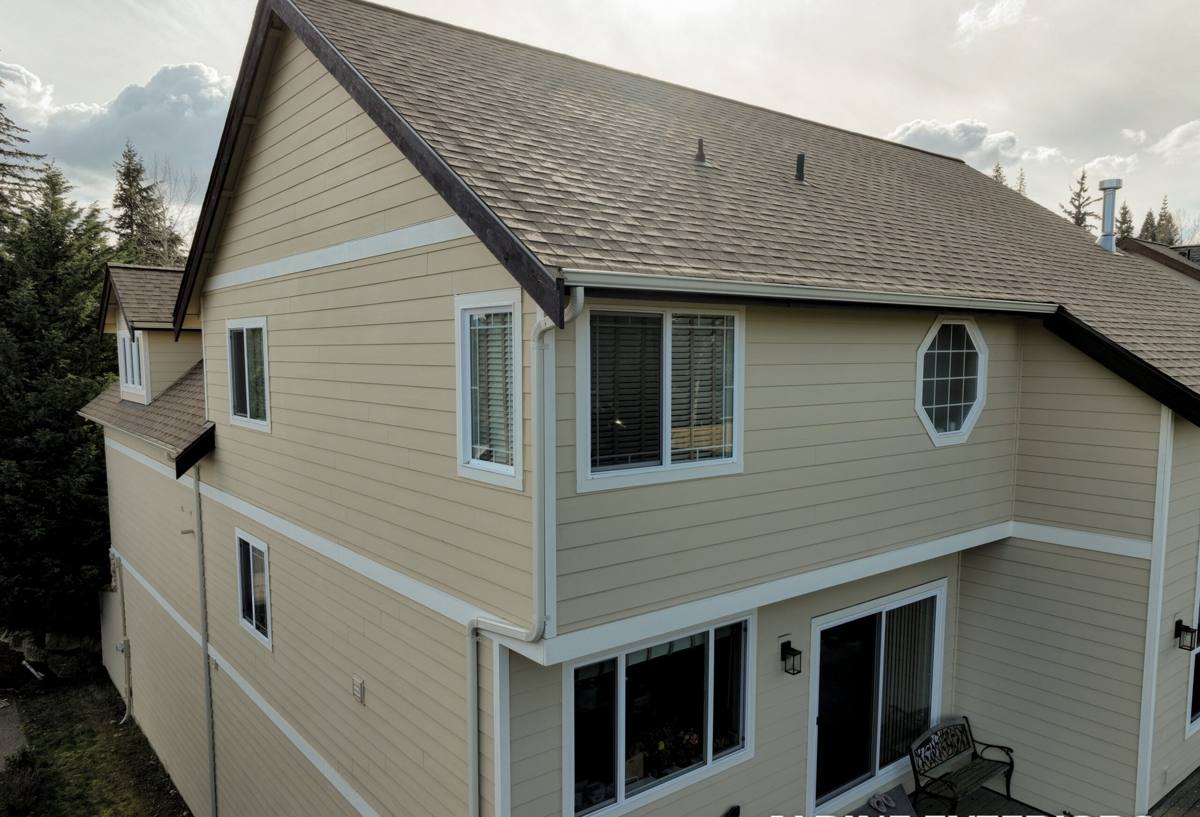
What the Local Climate Actually Does to Siding
Salt Air and Coastal Moisture
Homes closer to Bellingham Bay and the surrounding waterways deal with airborne salt that accelerates corrosion on unprotected fasteners and metal trim, and that can slowly break down lower-grade paint films over time. It's not as aggressive as an oceanfront property, but it's a real factor that inland siding products aren't always engineered to account for.
Driving Rain
Storms here often come in sideways off the water, not just straight down. That means siding doesn't just need to shed water on the face — the laps, joints, and butt seams need to actually resist wind-driven rain being pushed up and under the cladding. A siding system with poor lap geometry or gaps that open up as the material moves seasonally will let water in exactly where you can't see it.
Moss and Sustained Dampness
Bellingham's tree cover and cloud cover mean plenty of walls stay shaded and damp for long stretches, especially north and east elevations. Moss and algae take hold on any surface that stays wet long enough, and once established they hold moisture against the cladding around the clock instead of letting it dry between rains. Siding that absorbs water or that has seams moss can root into will hold onto that moisture far longer than a dense, factory-finished product.
Why We Install Only James Hardie Fiber Cement
We standardized this company on James Hardie products exclusively — no LP SmartSide, vinyl, Cemplank, Allura, primed spruce, or cedar. That's a deliberate call based on what actually holds up in this climate over decades, not just what looks good on install day.
- Non-combustible core: Hardie's fiber cement doesn't burn, which matters regionally given wildfire smoke seasons and any nearby brush exposure, and it simply removes a failure mode that wood-based products carry.
- ColorPlus factory finish: baked-on, not field-applied, which means far more consistent coverage and better resistance to the fading and peeling that field-painted products are prone to under repeated wet-dry cycling.
- Engineered for moisture, not just painted against it: the fiber cement substrate itself doesn't swell, rot, or delaminate the way wood-based sidings can when they take on water repeatedly.
- HZ5 product line: Hardie's climate-specific formulation for the Pacific Northwest's freeze-thaw and moisture cycling, rather than a one-size-fits-all national product.
- Transferable warranty: a real, documented warranty structure that matters if you sell the house before the siding's functional life is up.
To be fair to the alternatives: LP SmartSide and engineered wood products have improved and can perform reasonably when installed and maintained well. Vinyl is inexpensive and low-maintenance in the sense that it never needs paint. Cedar has a look some homeowners specifically want. We're not claiming those products are junk. We're saying that after years of servicing homes in this specific climate, we've seen enough of the long-term maintenance burden, moisture-related callbacks, and finish degradation on those products that we no longer put our name on installs using them. Hardie is what we stand behind.
What a Correct James Hardie Install Actually Involves
The product only performs as well as the installation. A lot of the siding problems we get called out to inspect in this county aren't product failures — they're installation shortcuts that let water get behind a perfectly good cladding.
The Non-Negotiables
- Proper weather-resistive barrier (house wrap) installed and lapped correctly before any siding goes up
- Rainscreen or drainage gap where conditions call for it, so water that does get behind the cladding has somewhere to go and dry out
- Correct fastener type, spacing, and penetration depth per Hardie's engineering specs — not shortcuts that void the warranty
- Proper clearance at grade, decks, and roof lines so siding never sits in standing water or snow
- Caulked and flashed joints at windows, doors, and penetrations — the majority of moisture intrusion happens at these transitions, not on the flat field of siding
- Correct lap dimensions and butt joint treatment to shed wind-driven rain rather than trap it
Where Bellingham's Climate Changes the Details
On shaded or heavily treed lots we pay closer attention to ventilation gaps and drainage planes, since those walls simply don't get the sun exposure to dry out quickly after a storm. On homes with more direct exposure to weather off the water, we're more careful about fastener selection and flashing details at trim and corners. None of this is exotic — it's just attention to the details that matter more here than they would in a drier inland climate.
Our Process for a Bellingham Siding Job
- On-site assessment: we look at the existing siding and sheathing condition, moisture history, sun/shade exposure per elevation, and any moss or algae staining that tells us where water has been sitting
- Sheathing and moisture check: if there's any sign of past water intrusion, we check what's underneath before covering it back up — no point installing new siding over a problem
- Weather barrier and drainage plane: installed to current best practice, not just "what's always been done"
- Hardie installation to manufacturer spec: correct fasteners, laps, and clearances, with extra attention at every window, door, and roofline transition
- ColorPlus color selection: factory-finished color chosen to hold up long-term rather than needing repainting in a few years
- Final walk-through: we go over the finished job with you before calling it done
Cost Factors for a Bellingham Siding Project
| Factor | Why It Matters Locally |
|---|---|
| Home size and elevation count | More wall area and more corners/transitions mean more flashing and joint detail work |
| Existing siding removal | Tear-off and disposal of old cedar, vinyl, or damaged material adds labor |
| Sheathing repair | Any moisture damage found underneath old siding needs to be addressed before re-siding |
| Drainage/rainscreen detail | Shaded, damp elevations often warrant a more robust drainage plane, which adds material and labor |
| Trim and accessory scope | Corner boards, window trim, and fascia in Hardie trim products vs. reusing existing trim |
| Color and product line | HZ5 panel, lap, and shingle styles vary in material cost and installation time |
We don't quote broad numbers in the abstract because every one of these factors changes the total meaningfully — an accurate number requires actually seeing the house.
Why Hiring a Crew That Already Works Bellingham Matters
A crew that's never worked this specific micro-climate doesn't necessarily know which elevations on a given lot stay damp longest, how moss behaves on different exposures around here, or which install details actually matter versus which are optional in a drier region. That's not a knock on out-of-area contractors — it's just that local, repeated experience with Whatcom County's rain patterns, tree cover, and coastal air catches details a generic install wouldn't necessarily prioritize. We work in this area regularly, which means we're not guessing at how a wall assembly will perform three winters from now — we've already seen how it holds up.
Signs Your Current Siding May Already Be Struggling
- Persistent moss or algae staining that comes back within a season of cleaning
- Peeling, bubbling, or chalking paint, especially on shaded elevations
- Soft or spongy spots when you press on the siding, particularly near the bottom courses or trim
- Visible gaps or warping at seams and corners
- Musty smell or visible staining on interior walls that back up to exterior siding
None of these mean you necessarily need a full re-side tomorrow, but any of them are worth having looked at before they turn into a sheathing or framing problem.
Get an Honest Look at Your Siding
If you're weighing a siding replacement in Bellingham, or you're just not sure whether what you have is holding up the way it should, we're happy to come take a look. There's no pressure and no obligation — just a straight assessment of where things stand and what your options actually are, using the fill-out form below.