 Sudden Valley Window
 Why Silver Beach Siding Wears Faster Than the Rest of Whatcom County
Silver Beach and the surrounding Sudden Valley area sit right up against Lake Whatcom, wrapped in tall evergreens that keep the shade heavy and the air damp most of the year. That combination — western Washington's marine climate, with salt-tinged air moving in off the Salish Sea, plus the humidity the lake itself holds against the hillside — means siding here rarely gets a real dry stretch to recover in. Rain doesn't just fall, it drives sideways off the water on windy days, working its way into seams and laps that would stay bone-dry somewhere more sheltered.
Then there's moss. Between the tree cover and the lake's moisture, north-facing walls and anything shaded by a roofline or a stand of firs can stay damp for weeks at a stretch. Moss and algae take hold in that environment, and once they're established they hold even more water against the siding surface than the weather alone would. It's a slow problem, which is exactly why it gets ignored until it isn't slow anymore.
None of this means Silver Beach homes are doomed to constant repairs. It means the margin for a sloppy install or a deferred repair is smaller here than in a lot of Whatcom County. A gap in caulking that would take five years to cause a problem in a drier neighborhood can cause one in two here.
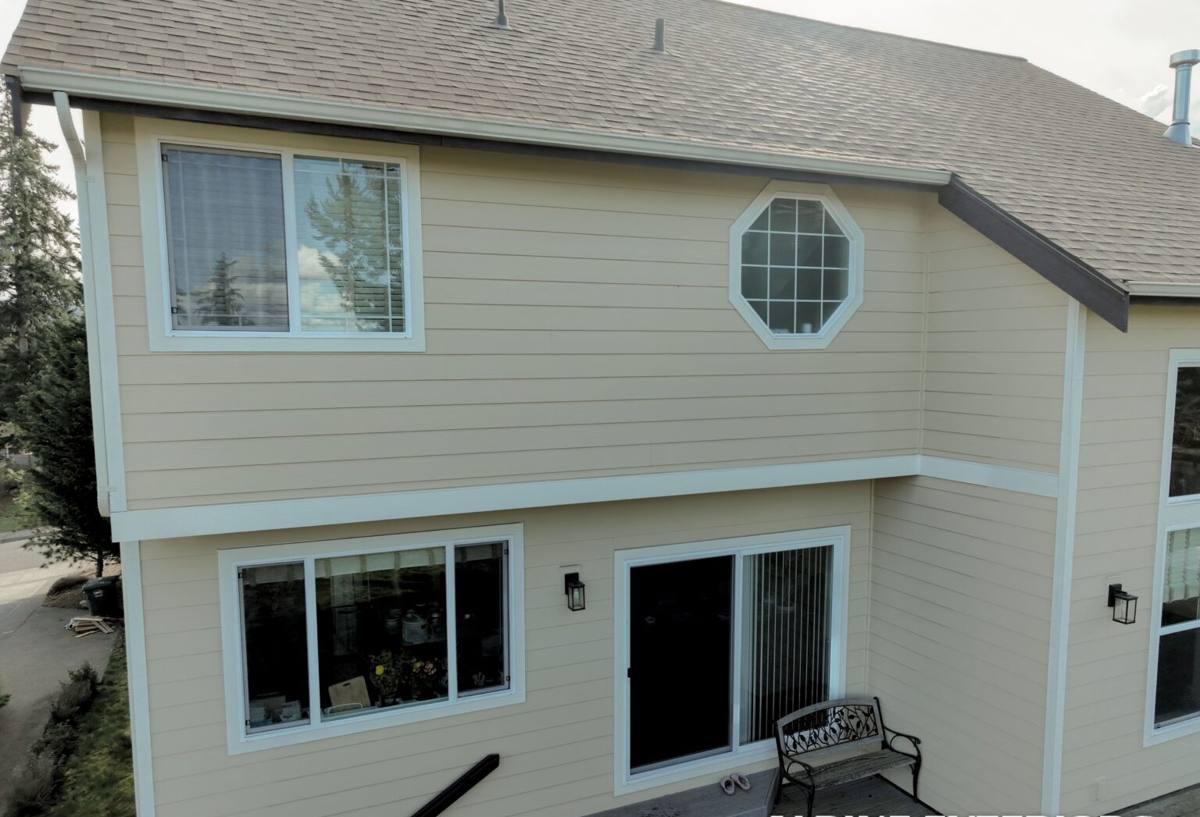
Cosmetic Damage vs. a Real Problem
Not every mark on your siding means trouble. Learning to tell the difference saves money and stress.
Usually Cosmetic
- Surface algae or moss film that wipes or washes off without leaving soft material behind
- Faded paint or finish on sun-exposed walls, with the material underneath still solid
- Minor scuffs or small dents from yard equipment or debris
Usually a Real Problem
- Soft, spongy, or crumbling material when you press on it
- Visible gaps, cracks, or separation at seams, corners, or trim
- Bubbling or peeling paint that keeps coming back in the same spot
- Staining or a musty smell on the interior wall behind the affected siding
- Boards that have cupped, bowed, or pulled away from the wall
The second list almost always points to moisture that's already gotten past the surface. At that point, repainting or caulking over it just hides the problem for another season.
What a Correct Siding Repair Actually Involves
Find the Water Source First
Damaged siding is a symptom, not the disease. Before anything gets cut out or replaced, we trace where the moisture is actually coming from — a failed flashing detail above a window, a gap where two materials meet, a downspout dumping water against a wall, or just years of driving rain finding a weak seam. Replace the damaged board without fixing the entry point and you'll be back in the same spot in a year or two.
Check What's Behind the Siding
Once damaged material is removed, we look at the sheathing and framing behind it. If water has been getting in for a while, it's not unusual to find soft sheathing or early rot that needs to be addressed before new siding goes back on. Skipping this step is the single most common shortcut in siding repair, and it's the one that costs homeowners the most down the line.
Match the Repair to the Wall, Not Just the Color
A patch that's the right color but the wrong material, thickness, or profile will telegraph as a visible seam and can behave differently in the weather than the surrounding wall — expanding, contracting, or absorbing moisture at a different rate. A correct repair accounts for how the new section will move and weather alongside what's already there.
Flashing, Fasteners, and Sealant Do the Real Work
The siding itself gets the attention, but it's the flashing, the fastener pattern, and the sealant at joints and penetrations that actually keep water out long-term. Corners get cut on cheap or rushed repairs — a few extra beads of caulk instead of proper flashing — and that's usually where the next failure starts.
Repair or Replace? How We Make the Call
Homeowners often assume any damage means the whole wall has to come off. Just as often, someone tries to patch a problem that's really telling them the whole run of siding is at the end of its life. Here's roughly how we sort it out:
| Situation | Localized Repair Usually Works | Full Replacement Usually Makes Sense |
|---|---|---|
| Extent of damage | One or two isolated boards or a small section | Damage spread across multiple walls or elevations |
| Underlying material condition | Sheathing and framing test solid once opened up | Rot or moisture damage found behind more than the visible spot |
| Age of existing siding | Siding is younger and otherwise in good shape | Siding is near or past its expected service life |
| Material on the house | Repair material can be closely matched | Original product is discontinued, faded, or prone to repeat failure |
| Root cause | A single fixable source (one flashing detail, one gap) | Systemic issues — grading, ventilation, or original installation errors |
Why We Rebuild Repairs in James Hardie, Not Whatever Was There Before
When a repair calls for new material, we install James Hardie fiber cement — that's the only siding product we put on a house, full stop. On a repair job that matters for a few practical reasons, not just brand preference.
If your existing siding is vinyl or LP SmartSide, patching in more of the same product usually means fighting the same weaknesses that caused the original damage. Vinyl expands and contracts with temperature and can warp or crack at fastener points over time; LP-style engineered wood siding relies on its factory coating staying intact everywhere, including at every cut edge, and any breach lets moisture into the wood strand core. Cedar and primed wood siding need ongoing paint maintenance to keep water out, and a repaired section rarely ages at the same rate as thirty-year-old boards next to it. None of that is a knock on those products doing what they were built to do — it's why we simply don't install any of them, on repairs or full jobs.
James Hardie is non-combustible fiber cement, engineered in HZ product lines for wetter climates, and finished with a factory-applied ColorPlus coating that resists fading and doesn't need the homeowner to keep repainting it. A Hardie patch section holds up under the same driving rain and moss-prone shade as the rest of the wall, and it carries a strong transferable warranty when installed to the manufacturer's specifications. We won't pretend a small repair patch will look invisible against faded original siding of a different material — color and texture matching across products has real limits — but we'll tell you honestly what to expect before the work starts, not after.
Our Silver Beach Siding Repair Process
- On-site inspection. We look at the visible damage, probe the material for softness, and check the surrounding area — not just the spot you called about.
- Find the cause. We identify where water is getting in, whether that's a flashing gap, a caulk failure, grading, or a ventilation issue.
- Open it up. Damaged siding comes off so we can see the sheathing and framing condition underneath before quoting the scope.
- Honest scope and price. You get a clear explanation of what's actually needed — repair, partial replacement, or a recommendation to replace more if the underlying damage warrants it — before we commit you to anything.
- Correct the water path first. Flashing, house wrap, and sealant details get fixed, not just covered over.
- Install and finish. New James Hardie material goes in to spec, fastened and sealed correctly, with color matched as closely as the situation allows.
- Walkthrough. We show you what was done and what to keep an eye on going forward.
Living With Moss Season: What Homeowners Can Do Between Visits
The long wet stretch that runs through much of the year in this part of Whatcom County isn't going away, but a few habits go a long way toward keeping small issues small:
- Keep gutters and downspouts clear so water isn't overflowing directly onto siding or pooling at the base of a wall
- Trim back branches and brush that keep a wall shaded and damp longer than it needs to be
- Rinse visible moss or algae buildup before it has a chance to hold moisture against the surface for months
- Check caulking at trim, windows, and corners once a year — it's cheap to redo and expensive to ignore
- Look inside at ceilings and walls near exterior corners for staining, which often shows up before the exterior damage is obvious
- Walk the exterior after a hard windstorm off the lake to check for anything knocked loose or pulled away
Why a Crew That Already Works Silver Beach Matters
A lot of homes around Lake Whatcom, Silver Beach included, started as smaller seasonal cabins that got winterized and added onto over the years, which means the walls behind the siding aren't always a clean, modern assembly. A crew that's worked in this area knows to expect that and knows what to look for rather than being surprised by it once the siding comes off.
Access matters too — narrow, tree-lined lots and private roads common around the lake mean logistics that a contractor unfamiliar with the neighborhood might not plan for. And a crew that regularly works Whatcom County's unincorporated lake communities already understands the permitting expectations for exterior work here, so a repair doesn't stall waiting on paperwork nobody checked ahead of time.
Just as important: a local crew has a reputation in the neighborhood to keep. That's a stronger incentive to do the flashing detail correctly and stand behind the work than a company that's driving in from out of the area for a one-time job.
Get a Straight Answer on Your Siding
If you're seeing soft spots, gaps, recurring moss, or paint that won't stop bubbling on a Silver Beach or Sudden Valley home, it's worth getting an honest look before it turns into a bigger repair. We'll tell you plainly whether it's a simple fix, a larger repair, or something that points to full replacement — no upsell, no scare tactics. Reach out below for a free, no-pressure estimate.