 Sudden Valley Window
 Silver Beach's Climate Is Hard on a Deck
Silver Beach sits close enough to Lake Whatcom, and close enough to the tree cover that surrounds Sudden Valley, that decks here age differently than they would in a drier, more open part of Whatcom County. Homes tucked under fir and cedar canopy get less direct sun on their decks, which means less drying time after every rain. Combine that with our long stretch of wet months and you get a deck surface that stays damp far longer than the manufacturer's spec sheet ever assumed. That's the root of most of the problems we see: moss and algae building up in shaded corners, ledger boards holding moisture against the house, and fasteners corroding faster than homeowners expect.
None of this means a deck in Silver Beach can't last for decades — it just means the build has to account for the site instead of following a generic template. A deck plan that works fine on a sunny, open lot on the county's east side can fail early here if it's built the same way.
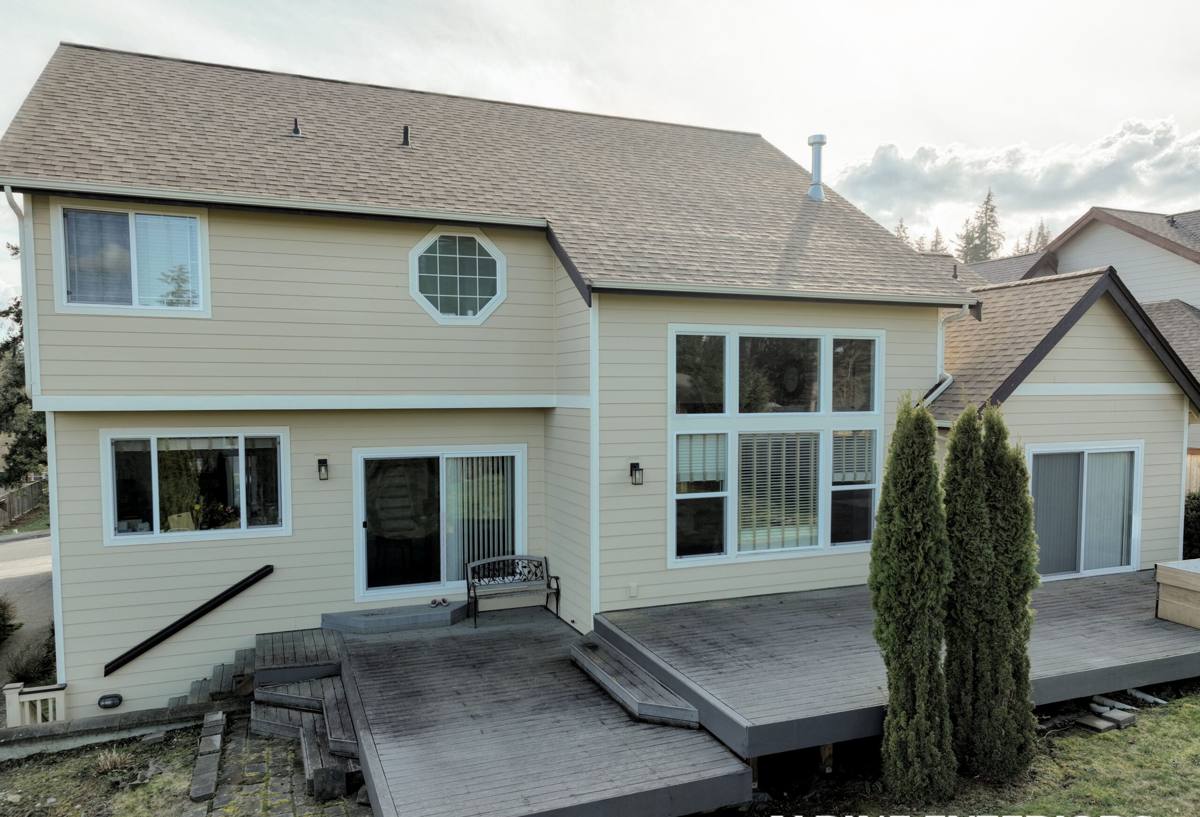
What a Correctly Built Deck Requires in This Setting
A deck that's going to hold up under Whatcom County's driving rain and long moss season needs a few things done right from the start, not fixed later:
- Footings set below frost depth and bearing on solid, undisturbed soil — lakeside lots can have inconsistent fill, so we don't guess, we dig and check.
- Ledger board flashing that actually sheds water away from the house rim joist, not just a bead of caulk. This is the single most common failure point on older decks we get called to repair.
- Positive drainage and airflow underneath the deck — a slight slope and enough clearance so the ground beneath doesn't stay saturated year-round.
- Corrosion-resistant hardware — hot-dip galvanized or stainless fasteners and joist hangers rated for ground contact and coastal-influenced moisture, not standard interior-grade hardware.
- Board spacing generous enough for water to drain through and air to circulate, which slows moss growth on the walking surface.
Skip any one of these and the deck may still look fine for a year or two, but the failures that follow — soft ledger framing, rusted hangers, slick moss-covered boards — are expensive to fix compared to what it costs to do them right the first time.
Choosing a Decking Material for This Climate
There's no single "best" decking material — there's a best material for how much upkeep a homeowner actually wants to do. Here's how the common options hold up specifically against Silver Beach's shade-and-moisture conditions:
| Material | Moisture & Moss Behavior | Maintenance | Typical Lifespan |
|---|---|---|---|
| Pressure-treated fir/pine | Absorbs moisture readily; needs sealing to resist rot and moss staining in shaded spots | Annual cleaning, re-seal every 1-2 years | 15-20 years with upkeep |
| Cedar | Naturally rot-resistant but still needs sealing to prevent graying and moss in low-sun areas | Clean and re-seal every 1-2 years | 15-25 years with upkeep |
| Composite (capped) | Won't rot, but shaded/damp spots can still grow surface algae that needs scrubbing off | Periodic washing, no sealing | 25-30 years |
| PVC/vinyl decking | Fully moisture-resistant; least prone to moss staining of the group | Occasional washing | 25+ years |
We install all of these. Our job is to walk a homeowner through the honest trade-offs — upfront cost versus ongoing maintenance versus how much shade the specific deck location actually gets — rather than push one product line. A deck that gets four hours of afternoon sun can often get away with wood if it's maintained; a deck tucked under mature trees is usually money better spent on composite or PVC over the life of the structure.
Railings, Stairs, and Permitting
Most decks built above a certain height off grade need guardrails, and most Western Washington jurisdictions follow similar baseline standards: guardrails generally need to be at least 36 inches tall, with gaps small enough that a young child can't slip through, and stair rise-and-run has to stay consistent step to step. The exact thresholds and paperwork depend on the deck's height, size, and whether it's attached to the house, so we pull the specifics for Whatcom County before we ever cut a board — not after.
Permitting matters more than a lot of homeowners realize. An unpermitted deck can complicate a home sale down the road, and it removes any inspection check on the footings and framing that are doing the actual structural work. We handle the permit application and inspections as part of the job, so it's one less thing on the homeowner's plate.
Working Within Sudden Valley and Silver Beach Property Rules
A number of properties in and around Sudden Valley fall under a homeowners association or architectural review process for exterior projects, decks included. Requirements vary by property and can cover things like material color, railing style, or how close a structure can sit to a lot line. We've worked enough jobs in this specific area to know that review step is coming, and we build it into the project timeline rather than treating it as a surprise. If a homeowner isn't sure whether their lot falls under a review process, that's one of the first things we help sort out during the initial visit.
How We Approach a Silver Beach Deck Project
- Site visit and consultation. We walk the lot, check sun/shade exposure, existing drainage, and how the deck will tie into the house.
- Design and material selection. We lay out size, layout, and material options with honest cost-versus-upkeep numbers for this specific site.
- Permitting and any association review. We prepare and submit what's needed for Whatcom County and, where applicable, the property's architectural review.
- Construction. Footings, framing, flashing, decking, and railings — built to the standards above, not shortcut versions of them.
- Final walkthrough. We go over the finished deck together, including basic care guidance specific to the site's sun exposure.
Keeping a Silver Beach Deck Ahead of Moss and Moisture
Even a well-built deck needs some seasonal attention in this climate. A short annual routine goes a long way:
- Sweep leaves and needles off the deck surface regularly — trapped debris under the canopy holds moisture against the boards.
- Keep gutters and downspouts near the deck clear so runoff isn't dumping directly onto or under it.
- Check that gaps between boards stay clear of packed debris so water and air can still move through.
- Re-seal wood decking on the schedule the product calls for — don't wait until it's visibly gray or cracking.
- Wash composite or PVC surfaces when you notice green or black buildup, especially in shaded corners.
- Inspect the ledger flashing and fasteners once a year for rust streaks or gaps in the seal.
- If tree limbs overhang the deck, keep them trimmed back to cut down on shade and falling debris.
What Affects the Cost of a Custom Deck Here
| Factor | Why It Moves the Price |
|---|---|
| Site access and slope | Lakeside and wooded lots often need extra excavation or hand-digging for footings |
| Decking material | Wood costs less upfront; composite and PVC cost more but need far less upkeep |
| Height off grade | Taller decks need more substantial framing, stairs, and guardrail work |
| Railing style | Cable, glass, or custom rail systems cost more than standard baluster railing |
| Permitting/review complexity | Architectural review adds time and sometimes design constraints, not usually direct cost |
As a broad range, custom deck projects in this area typically run in the low-to-mid tens of thousands of dollars depending on size, material, and site conditions — a real number for any specific property only comes from an on-site look.
Why a Crew That Already Works Silver Beach Matters
Building a deck here isn't just carpentry — it's carpentry with a working understanding of how this particular stretch of Whatcom County behaves. That means knowing which lots hold water longer after a storm, which properties are likely to need architectural review before permits, and how much shade a given tree line will actually put on a deck through the seasons. A crew that's done this work in Silver Beach and the surrounding Sudden Valley area isn't learning those lessons on your project — they've already priced them in, planned for them, and built accordingly.
If you're weighing a new deck or replacing one that's showing its age, we're happy to come take a look and talk through what makes sense for your specific lot. The estimate is free, there's no pressure, and you'll walk away with a clear picture of the options and what they cost.