 Sudden Valley Window
 Decking in Silver Beach Has to Deal With Water First, Looks Second
Homes around Silver Beach sit in one of the wetter, greener corners of Whatcom County, and that shows up on decks faster than almost anywhere else on the exterior of a house. Salt-laden air off the water works into fasteners and framing connectors. Driving rain off Lake Whatcom's weather systems finds every gap in a board layout that wasn't planned for drainage. And the long moss season here — often stretching from fall through spring — turns any deck surface that stays damp and shaded into a slick, green problem within a season or two. A composite deck built without those three things in mind will look fine at installation and disappoint an owner within a couple of winters.
This page is specifically about composite decking for Silver Beach properties — not a general decking overview. The framing choices, board spacing, drainage detailing, and maintenance schedule we recommend here are shaped by what actually happens to decks in this microclimate, not a generic install spec pulled from a manufacturer brochure.
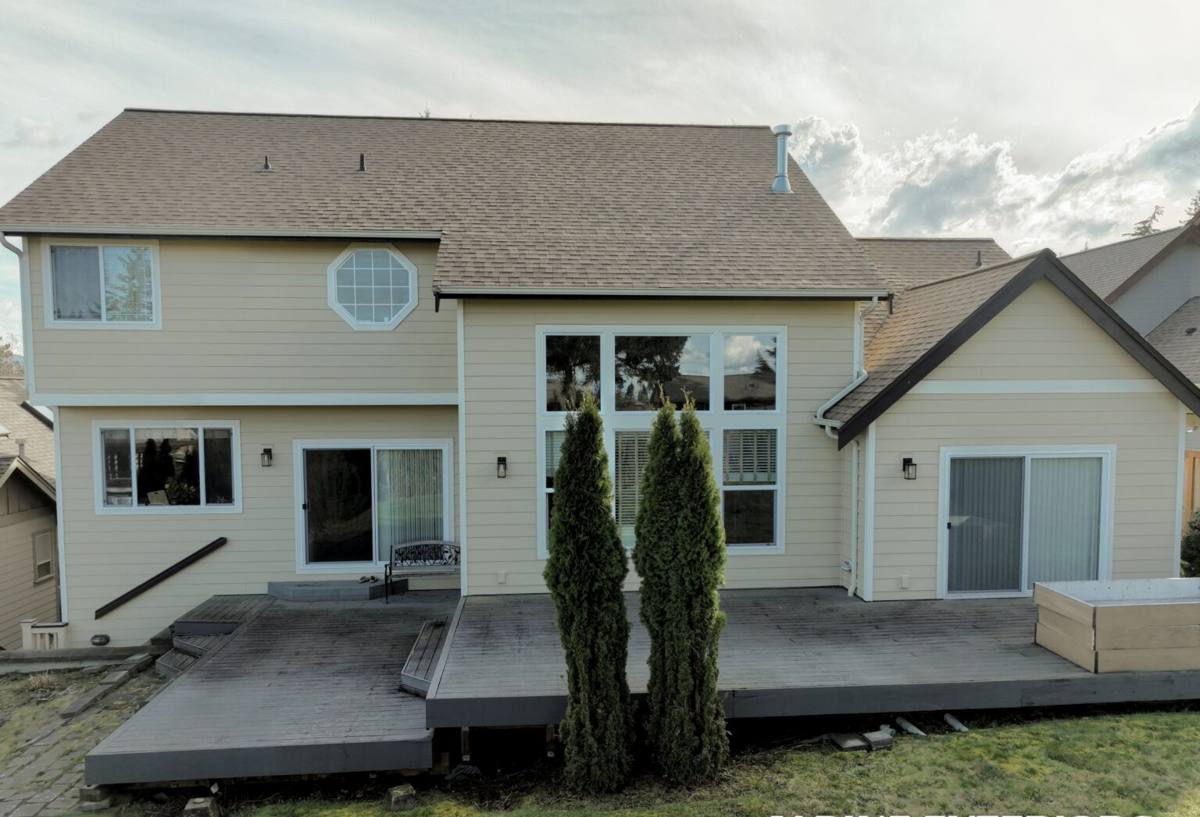
What the Local Climate Actually Does to a Deck
Moisture That Doesn't Dry Out Quickly
Composite decking is marketed as low-maintenance, and compared to wood it is. But "low-maintenance" doesn't mean "ignore drainage." Composite boards don't rot the way wood does, but the substructure underneath them — joists, beams, ledger connections, hardware — absolutely can if water is allowed to pool or sit against it. In a climate where the ground rarely dries out completely for months at a time, that substructure work matters more here than it would in a drier region.
Moss and Algae Growth
Shaded decks, north-facing decks, and decks under tree canopy in this area grow moss and algae faster than most homeowners expect. It's not a defect in the decking — it's the climate. The right board choice (capped composite with a textured, moisture-resistant surface) and the right layout (adequate airflow underneath, gapping that lets water shed instead of channel) reduce how often it becomes a problem, but nothing eliminates it completely in a spot that gets this much shade and rain.
Salt Air and Hardware
Even set back from open water, homes in this part of Whatcom County get enough salt-influenced air to accelerate corrosion on lower-grade fasteners, brackets, and post bases over time. This is one of the most common places we see corners cut on decks that were built cheaply — galvanized hardware that was fine for a dry inland build starts showing rust streaks on composite boards within a few seasons here.
What a Correct Composite Deck Build Involves
A composite deck is only as good as what's underneath it. The board itself gets most of the attention, but the framing, fasteners, and drainage detailing are what determine whether the deck is still solid and good-looking in fifteen years.
- Framing and ledger connection: proper ledger flashing where the deck attaches to the house, correctly sized joists for the span, and joist spacing tightened up from standard wood-deck spacing where composite manufacturers call for it (composite boards typically need closer joist spacing than dimensional lumber decking).
- Fasteners and hardware: stainless steel or coated fasteners rated for coastal/marine-adjacent exposure, not the generic galvanized hardware used on inland dry-climate builds.
- Hidden fastening systems: most composite lines are designed for hidden clip systems rather than face-screwing, which also reduces the number of penetration points where water and grime can collect.
- Board gapping: spacing set for the specific board's expansion and drainage needs, not a one-size-fits-all gap — this matters more in a wet climate where boards need to shed water quickly.
- Airflow underneath: adequate ground clearance and, where the site allows, skirting that doesn't trap moisture against the framing.
- Post bases and footings: set above grade and detailed so standing water isn't sitting against post bottoms through the wet months.
Skipping any one of these doesn't usually show up on day one. It shows up as squeaks, soft spots in the substructure, staining, or hardware failure a few years down the road — usually after the original installer is long gone.
Composite vs. Other Decking Options for This Climate
We install composite because, for this specific climate, it holds up better with less ongoing work than the alternatives most homeowners are choosing between. Here's how the honest trade-offs break down:
| Material | Moisture Behavior Here | Maintenance | Typical Lifespan |
|---|---|---|---|
| Capped composite | Resists moisture absorption well; surface sheds water and resists staining | Periodic cleaning to manage moss/algae; no staining or sealing | 25+ years with proper substructure |
| Pressure-treated wood | Absorbs moisture, swells/shrinks seasonally, prone to rot at fastener points | Annual sealing/staining recommended in a wet climate | 10-15 years before major repair |
| Cedar | Naturally rot-resistant but still absorbs moisture; splinters and grays without upkeep | Regular sealing to preserve color and resist moss | 15-20 years with upkeep |
| Uncapped/older composite | More prone to moisture absorption and staining than modern capped boards | More prone to mold/mildew staining in constant damp | Shorter service life in wet climates |
We'll walk any homeowner through why we prefer capped composite for decks in this area specifically — it isn't about one product being "bad," it's about what performs with the least ongoing maintenance burden given how much rain and shade this area actually gets.
Board Style and Color Considerations
Darker composite boards run hotter in direct sun but hide moss shadowing and organic staining better on shaded decks — a real consideration for lots with tree cover near the lake. Lighter boards show dirt and pollen more but stay cooler underfoot on the few decks here that get full sun exposure. We talk through this with homeowners based on their specific lot's sun and shade pattern, not a blanket recommendation.
Our Process for a Silver Beach Deck Project
- On-site assessment: we look at drainage on the lot, existing framing condition (for replacement projects), sun/shade exposure, and how water currently moves around the house.
- Design and material selection: board style, color, and layout matched to the site's exposure, plus a framing plan sized correctly for composite (not just reused wood-deck spacing).
- Permitting: deck permits and inspections handled through the appropriate local building department for the project's location and scope.
- Demolition (if replacing): old decking and, where needed, compromised framing removed and hauled off.
- Framing and flashing: ledger flashing, joist layout, hardware, and post footings installed to spec for this climate — not the minimum code allows.
- Composite installation: hidden-fastener board installation with correct gapping and edge detailing.
- Final walkthrough: we go over cleaning recommendations and what to watch for seasonally, specific to the deck's orientation and shade.
Cost Factors on a Composite Deck Project
Every deck is priced on its own specifics, but the line items that move the number the most tend to be the same ones on most Silver Beach projects:
| Factor | Why It Affects Cost |
|---|---|
| Deck size and shape | Square footage plus complexity of angles, curves, or multiple levels |
| Framing condition or replacement scope | New build vs. resurfacing over existing (sound) framing changes labor significantly |
| Height and access | Elevated decks, stairs, and railings on sloped lots near the lake add engineering and labor |
| Board tier | Composite lines range from entry-level capped boards to premium multi-tone options |
| Railing and fascia choices | Composite or metal railing systems vs. simpler wood/composite fascia trim |
| Site access | Tight lots, slopes, or limited equipment access add time |
We give straightforward, itemized estimates rather than a single number with no explanation of what's driving it — that way homeowners can see exactly where their budget is going.
Maintaining a Composite Deck in This Climate
Composite is genuinely lower-maintenance than wood, but "no maintenance" is a myth anywhere in Whatcom County's wet, shaded terrain. A short seasonal routine keeps a deck looking and performing the way it should:
- Sweep debris (needles, leaves, moss spores) off regularly through fall and winter so it doesn't sit and hold moisture against the board surface.
- Rinse the deck a few times a year with plain water and a soft-bristle brush to keep early moss/algae growth from taking hold.
- Check gutters and downspouts near the deck — misdirected roof runoff onto a deck surface accelerates staining and moss growth more than rain alone.
- Keep planters and furniture feet from sitting directly on boards for months at a time without moving them; trapped moisture under a static object is a common spot for staining.
- Inspect railing posts and stair stringers annually for any movement, since these connections take the most structural stress.
- Address any moss growth promptly with a composite-safe cleaner rather than a pressure washer on high pressure, which can damage the board's cap layer.
Why Hire a Crew That Already Works Silver Beach
A deck crew that mostly builds in drier, sunnier parts of the state will default to specs that work fine there and underperform here. The joist spacing, hardware grade, drainage detailing, and board selection we use on Silver Beach decks come from having actually seen how decks in this specific area age — which sides of a house grow moss first, where roof runoff causes problems, and which hardware holds up against the local air and moisture year after year. That's not something a generic estimate from an out-of-area contractor typically accounts for.
We also know the local permitting process and the practical realities of building on the sloped, tree-covered lots common around the lake — access, footing depth on variable soil, and working around established landscaping without unnecessary damage.
Get a Free Estimate for Your Silver Beach Deck
If you're planning a new composite deck or replacing a tired one, we're happy to come take a look, walk the site with you, and put together a straightforward, no-pressure estimate. Use the form below to get started.